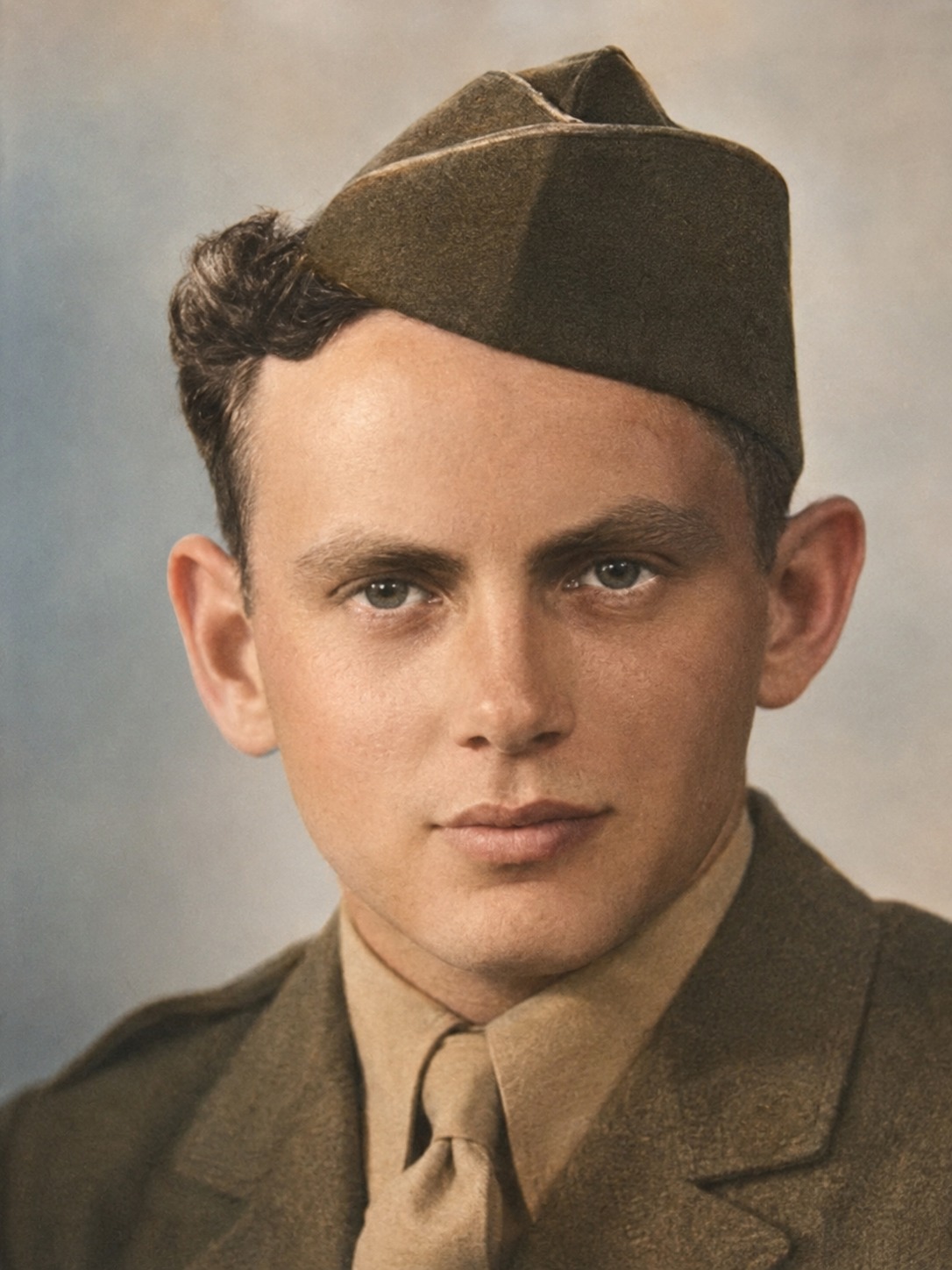
Portrait of Ottie Owen Oldham Jr. in uniform
A World War II Service Record

Ottie Owen Oldham Jr.

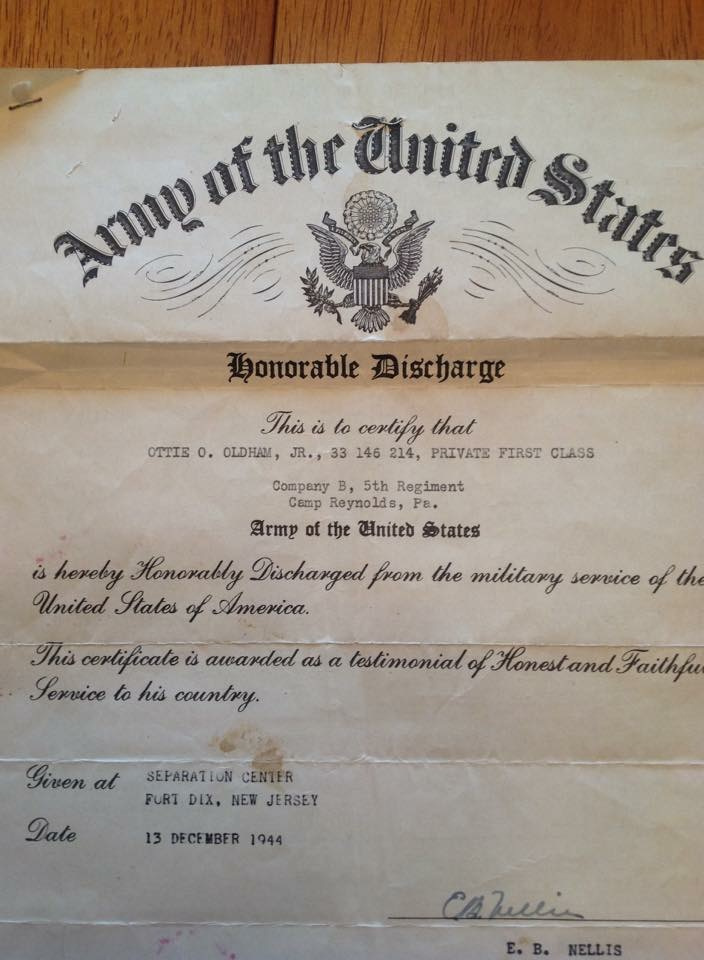
Private First Class (Pfc) · Company B, 5th Regiment, Camp Reynolds, Pennsylvania
Army · Service no. 33 146 214
Service Number
33 146 214
Rank
Private First Class (Pfc)
Final Unit
Company B, 5th Regiment, Camp Reynolds, Pennsylvania
MOS
835 — Supply Clerk (earlier: 521 Basic Tng Inf; 1607 Heavy Mortar Crewman, 81mm)
Theater
European and North African theaters
This timeline reconstructs Ottie's World War II service from the Honorable Discharge and branch-appropriate National Archives unit records, searched by service number. Each entry cites its source; items marked Newly discovered were recovered from the records.

Map of Service

Route reconstructed from confirmed locations.

Map of Ottie Owen Oldham Jr.'s documented WWII service route

North Africa and Sicily: the campaign in detail. Stops marked (Co. H) are the company's documented stations.

Map of Ottie Owen Oldham Jr.'s WWII service in North Africa and Sicily

Service Timeline

33 min
Family record
April 27, 1920

Born in Evans, Jackson County, West Virginia

Ottie Owen Oldham Jr. is born in Evans, Jackson County, West Virginia.
Family record
May 24, 1940

The 1940 census finds him at Ripley, West Virginia

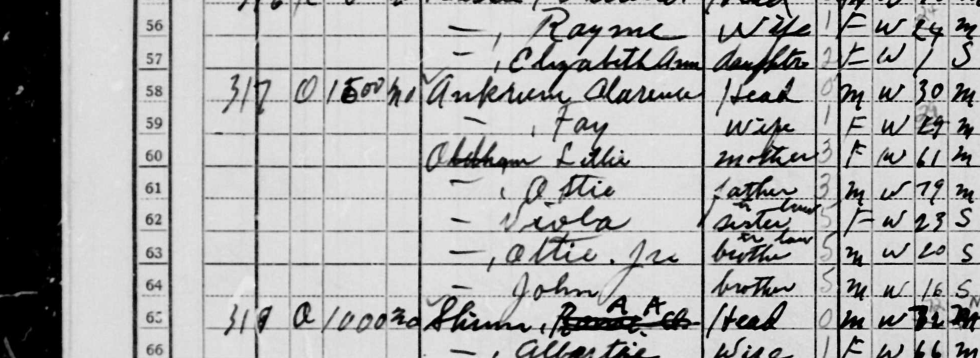
At twenty, a year out of high school and still looking for work, he is living in his married sister Isabelle Faye's household in the Ripley District of Jackson County. Her husband Clarence Ankrum heads the house. His parents Ottie Sr. and Lillie are there too, with his younger sister Viola and his brother John.
scanned record
The Oldham household in the 1940 census.
Source: 1940 U.S. Census, Jackson Co., W. Va., Ripley District, ED 18-10, Sheet 17B, household 317
Confirmed — Discharge
July 1, 1941

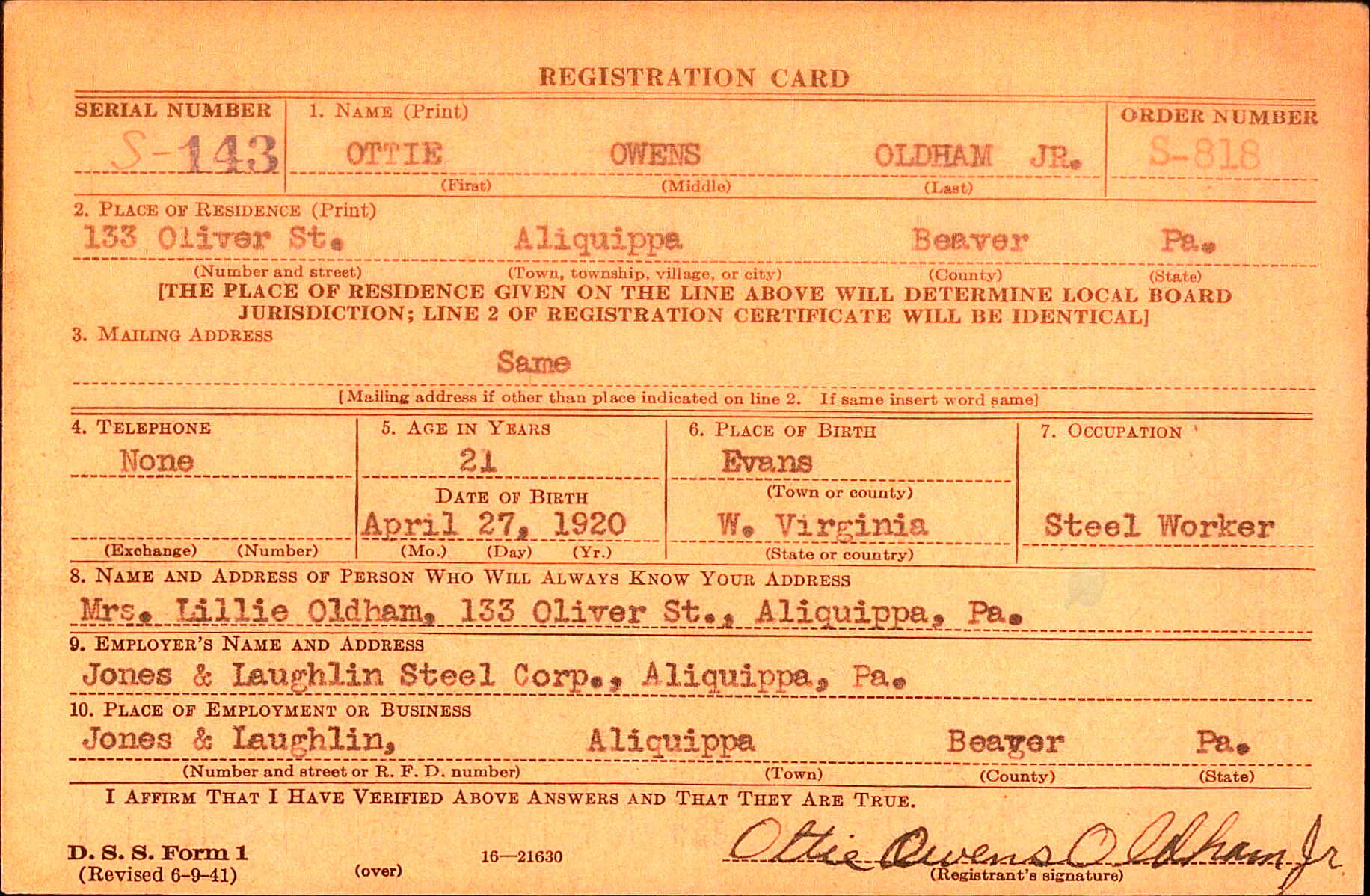
Aliquippa, Pennsylvania: he registers for the draft

He had left West Virginia for the steel town of Aliquippa and a job at Jones & Laughlin Steel. His registration card gives 133 Oliver Street, lists his mother Lillie at the same address, and carries his own signature. This is the first record placing him in the town he came home to and worked in for the rest of his life.
scanned record
His draft card: 133 Oliver Street, and the steel mill he was drafted out of.
Source: Selective Service Registration Card (DSS Form 1), Local Board No. 7, Aliquippa, Pa., 1 July 1941 — Serial S-143, Order S-818. The serial and order numbers are Selective Service numbers, not his Army serial number.
Confirmed — Discharge
January 27, 1942

Inducted into the Army

Inducted at New Cumberland, Pennsylvania.
Source: Honorable Discharge (WD AGO Form 53-55)
Confirmed — Discharge
January 27, 1942

Entered active service

Reported for active duty at New Cumberland, Pennsylvania.
Source: Honorable Discharge (WD AGO Form 53-55)
Context / in progress
May – July 1942

What Company H was

A word on the cards with a hollow marker, like this one. They describe the units and places around Oldham, drawn from the U.S. Army’s published campaign histories. Those volumes record regiments and battalions rather than individual men: they name the 16th Infantry, and they never name Company H or the men in it. So these cards say ‘the company’ or ‘the battalion’. The cards with a solid marker are the documents that name Oldham by service number.

Company H was the heavy weapons company of the 2nd Battalion, 16th Infantry: the company that carried the battalion’s 81mm mortars and heavy machine guns rather than rifles. The War Department published the manual for this kind of company, Heavy Weapons Company, Rifle Regiment, on 19 May 1942, the same week the company took Oldham on at Camp Blanding. A rifle regiment kept one such company in each battalion to give the riflemen fire they could not carry themselves.
Source: FM 7-15, Infantry Field Manual, Heavy Weapons Company, Rifle Regiment, War Department, 19 May 1942 — ibiblio.org/hyperwar, U.S. Army Field Manuals
Confirmed — Unit record
May 16, 1942

Camp Blanding, Florida: assigned to Company H

Four months after he was drafted, the Army gave him the company he would fight with. Company H’s morning report for 15 May lists the recruits joining it, and he is at the end of the line:
“RCTS. ASSIGNED TO CO. ‘H’ 16TH INF. … O’BRIEN, OLDHAM, AS OF THE 16th.”
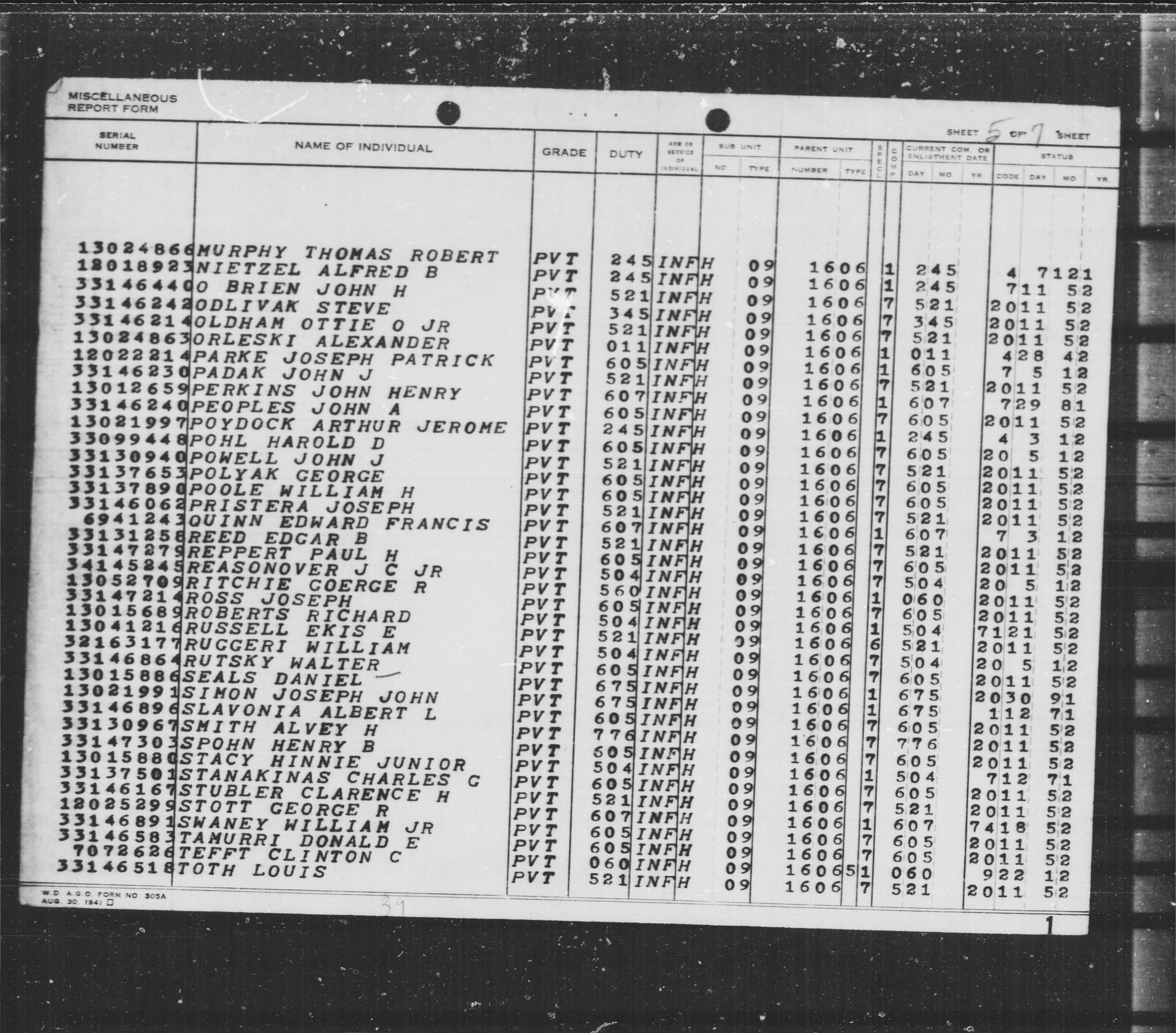
The clerk wrote surnames and no service numbers, so on its own that line could have been any Oldham. The company’s own tabulated roster settles it, printing the number against the name:
“33146214   OLDHAM OTTIE O JR   PVT   521   INF   H”
521 is the Army’s code for basic infantry training, the first of the three jobs listed on his separation papers. He had not yet been made a mortarman.
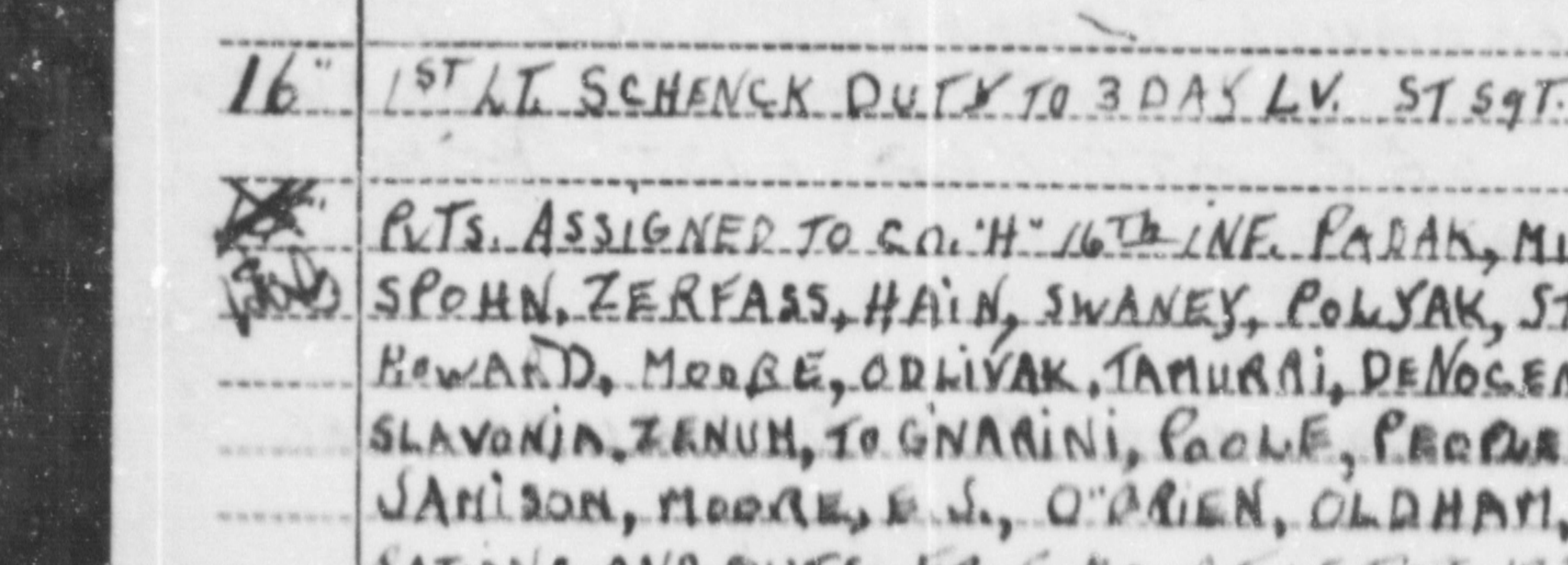
Two names above his on that roster are John O’Brien and Steve Odlivak, the men the assignment entry printed beside him. Odlivak was inducted the same day he was; O’Brien the day before. The three stayed together into North Africa.
scanned record
“RCTS. ASSIGNED TO CO. ‘H’ 16TH INF.” — Camp Blanding, 15 May 1942.
scanned record
The company roster: his service number, his grade, and Company H.
Source: Company Morning Report, Co. ‘H’, 16th Infantry, Camp Blanding, Florida, 15 May 1942 — NARA RG 64, Morning Reports January 1940 – July 1943, Roll 1567 (3 of 4), NAID 435020421, image 2233. Roster: Miscellaneous Report Form, Company H, 16th Infantry — Army & Army Air Force Rosters 1940–1943, Number 1502 (3 of 3), NAID 375701401, image 2309
Confirmed — Discharge
July 1, 1942

Sailed for the European and North African theaters

Departed the United States for the theater of operations.
Source: Honorable Discharge (WD AGO Form 53-55)
Context / in progress
July – October 1942

England

The 1st Infantry Division sailed for England in the summer of 1942 and trained there through the autumn. It had spent 1941 on the Atlantic coast learning to land on a defended shore, working alongside the 1st Marine Division; the 9th Infantry Division took over that role when the division left for the United Kingdom. The landing rehearsals were the point. In England the division was preparing for a major amphibious landing, though the men rehearsing it were not told where it would fall.
Source: Howe, Northwest Africa: Seizing the Initiative in the West (U.S. Army in World War II), ch. IV — ibiblio.org/hyperwar/USA/USA-MTO-NWA
Context / in progress
1942

The mortar and the men who fed it

The 81mm mortar was the heaviest thing a foot soldier could carry into the line. Its manual called it the weapon that ‘combines mobility and power in greater degree than any other supporting weapon’, with an explosive shell comparable to a 75mm gun’s and a useful range of about 2,000 yards. Broken into loads, the weapon and its ammunition were carried forward by the squad on foot. A mortar squad’s ammunition bearers hauled the rounds forward and fed them to the crew, and when the crew took losses the bearers stepped up to serve the weapon themselves. It was heavy work close to the front, feeding the gun the whole company was built around.
Source: FM 7-15, Heavy Weapons Company, Rifle Regiment, 19 May 1942 — the platoon sergeant ‘supervises the activities of ammunition bearers’; on reorganization, ‘ammunition bearers or basic privates replace other casualties’. Weapon characteristics: FM 1-26. ibiblio.org/hyperwar
Confirmed — Campaign credit
November 8–11, 1942

Algerian-French Moroccan campaign

Earned battle-star credit for the Algerian-French Moroccan campaign. He came ashore in French North Africa on the opening day of Operation TORCH.
Source: Campaign credit — Honorable Discharge (WD AGO Form 53-55)
Context / in progress
November 8, 1942

Ashore in North Africa: the Oran landings

Operation TORCH put the 1st Infantry Division ashore around Oran on 8 November 1942, its first day of the war, against Vichy French resistance. The 2nd Battalion, 16th Infantry came ashore that morning, was released from reserve, and was sent inland toward Fleurus on the division’s southern flank. Over the next two days the battalion relieved another at Fleurus and pushed up the Fleurus–Oran road, running into a sharp fire fight near St. Eugène before the Oran garrison gave up on the 10th.
Source: Howe, Northwest Africa, chs. XI–XII — the 2nd Battalion, 16th Infantry (Maj. Joseph B. Crawford). ibiblio.org/hyperwar/USA/USA-MTO-NWA
Confirmed — Campaign credit
November 1942 – May 1943

Tunisian campaign

Earned battle-star credit for the Tunisian campaign. Six months of fighting across Tunisia, ending in May 1943 when the Axis armies in Africa surrendered.
Source: Campaign credit — Honorable Discharge (WD AGO Form 53-55)
Confirmed — Unit record
November 1942

On the company’s payroll in North Africa

Company H’s pay roll for November 1942, the month he landed with Operation TORCH, carries three men in a row who had been together since Florida:
19. O’Brien, John H.   33146440   Jan 28/42
20. Odlivak, Steve   33146242   Jan 27/42
21. Oldham, Ottie O. Jr.   33146214   Jan 27/42
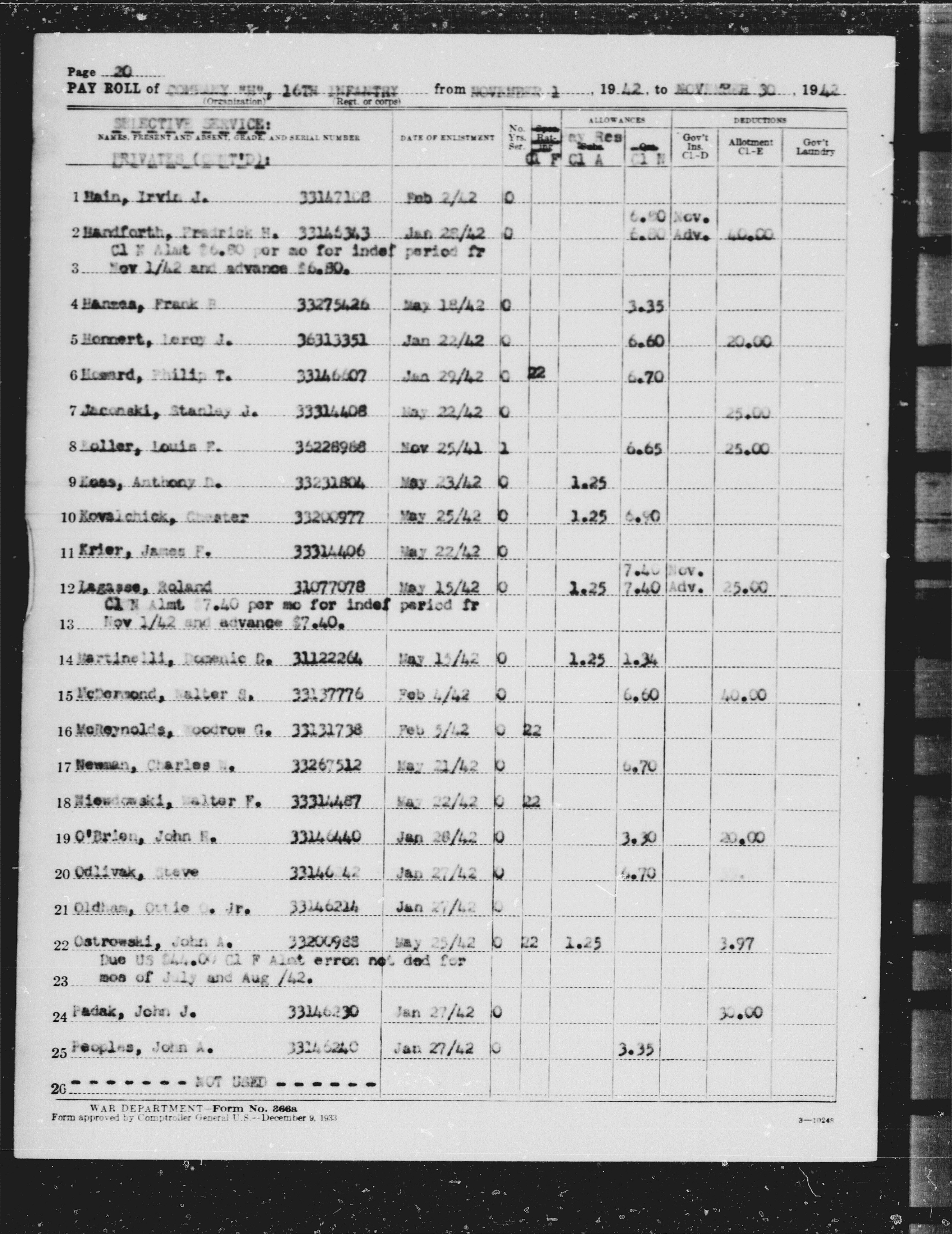
The date beside each name is the day the Army took him. His reads Jan 27/42, which is the date on his discharge certificate.
The same month, the company’s morning report has him sick in quarters from the 1st to the 5th: four days off duty, no hospital, while the regiment moved toward Oran.
scanned record
Company H’s November 1942 pay roll.
Source: Pay Roll of Company ‘H’, 16th Infantry, 1–30 November 1942, page 20 — NARA RG 64, Army & Army Air Force Rosters 1940–1943, Number 1502 (3 of 3), NAID 375701401, image 2275
Context / in progress
Winter 1942–43

Tunisia: the Kasserine winter

Through the winter the 1st Division fought east across Tunisia, and in February 1943 it met Rommel’s counteroffensive at Kasserine. On 20 February the 2nd Battalion, 16th Infantry moved to the northern edge of the Bou Chebka plateau; its companies, attached to Combat Command B, held ground near Bou Chebka pass among Senegalese troops while the German armour drove for the Kasserine gap. The battalion waited at the crossroads east of Djebel el Hamra for the order to counterattack, in the U.S. Army’s first hard fight against the Germans.
Where Oldham was in these weeks rests on Company H’s pay rolls, which carry the service number 33146214 in November 1942 and again in June 1943, with no surviving document in between. The battalion’s movements are its own; they are not a record of Oldham’s.
Source: Howe, Northwest Africa, chs. XXIII–XXIV — the 2nd Battalion, 16th Infantry at Bou Chebka pass and Djebel el Hamra. ibiblio.org/hyperwar/USA/USA-MTO-NWA
Context / in progress
Spring 1943

Gafsa, El Guettar, and the last hills

In the spring the 1st Division went over to the attack in southern Tunisia. The 16th Infantry helped take Gafsa on 17 March, then fought at El Guettar at the end of the month, where the regiment’s advance on Hill 482 had to cross four miles of open ground in full view of the enemy. The official history called it ‘slow and costly’. The regiment took Hill 469 in late April. When the Axis armies in Africa surrendered in May, the campaign the division had opened at Oran was finished.
The famous fight for Hill 609 in these same days belonged to the 34th Division, not the 16th Infantry; the regiment held the neighbouring high ground at Hill 531. And as with the winter, the pay rolls are what place Oldham in the company, not the regiment’s battle map.
Source: Howe, Northwest Africa, chs. XXVIII (Gafsa), XXIX (El Guettar), XXXII (Hill 469), XXXIII (Hill 609 was the 34th Division’s). ibiblio.org/hyperwar/USA/USA-MTO-NWA
Context / in progress
May – June 1943

Out of the line at Saint Leu

After Tunisia the company pulled back to the Algerian coast to refit and rehearse the next landing. Company H’s own morning reports place it at Saint Leu and then Staoueli, near Algiers, through the early summer. The 2 June report at Saint Leu shows the company being rebuilt: twelve enlisted men attached from the 1st Replacement Depot for rations, quarters and administration, filling the gaps Tunisia had left. These weeks were the pause between the desert and Sicily.
Source: Company Morning Reports, Co. ‘H’, 16th Infantry, Saint Leu, Algeria, 2 June 1943 — NARA RG 64, Roll 1567 (3 of 4), NAID 435020421, image 2577. Saint Leu and Staoueli appear in the company’s reports, not in the published histories
Confirmed — Unit record
June 1943

A month before Gela

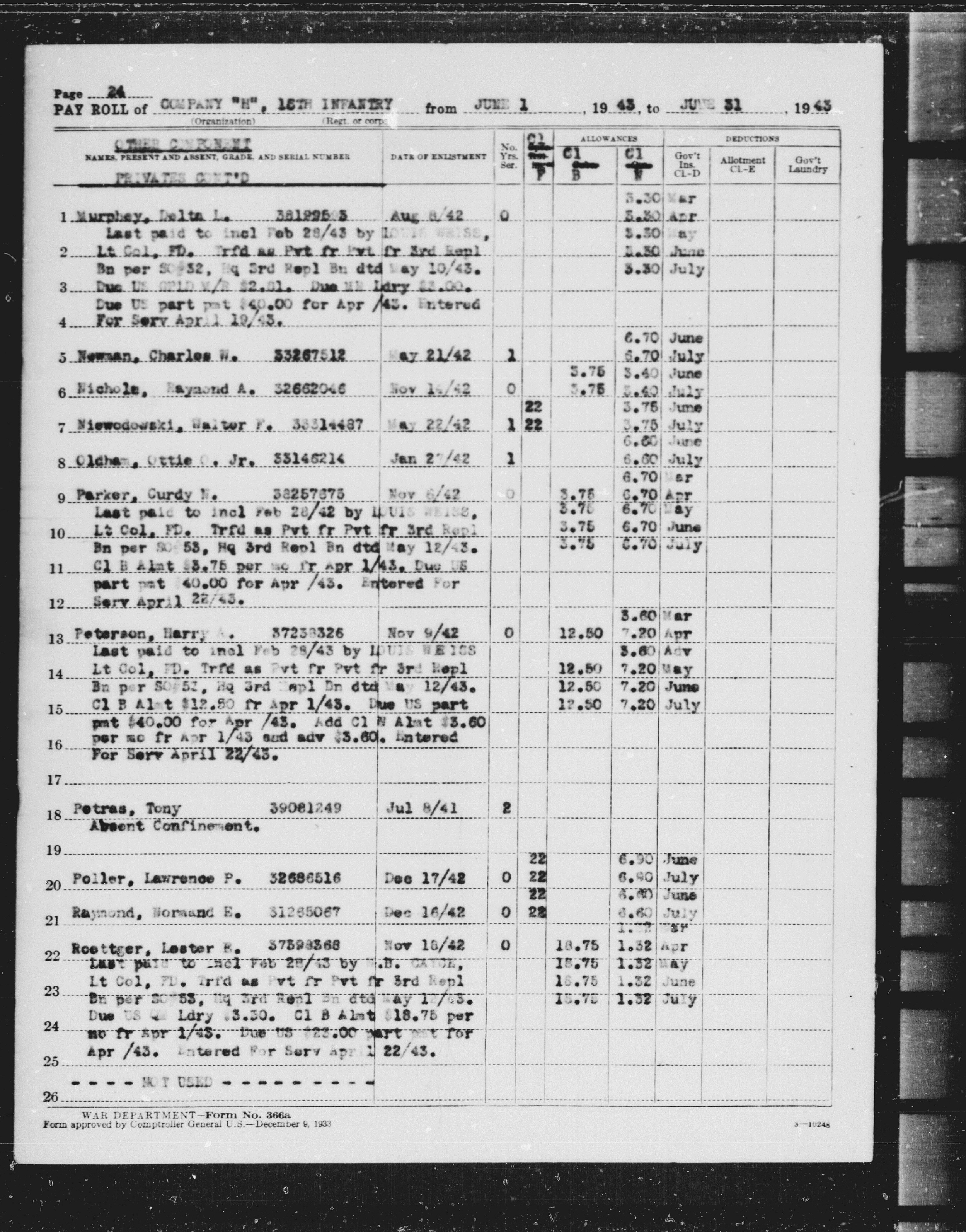
Company H’s June 1943 pay roll carries him as line 8, still with the same enlistment date beside his name. Tunisia was finished and Sicily was a month away.
This is the only record in the case for June 1943.
scanned record
June 1943: line 8 on his company’s pay roll.
Source: Pay Roll of Company ‘H’, 16th Infantry, 1–30 June 1943, page 24 — NARA RG 64, Army & Army Air Force Rosters 1940–1943, Number 1502 (3 of 3), NAID 375701401, image 2171
Context / in progress
July 1943

The convoy to Sicily

In the first week of July the 1st Division loaded onto its invasion transports off Algeria and sailed for the south coast of Sicily. The 16th Regimental Combat Team would land on the beaches in front of Gela, in the centre of the U.S. Seventh Army’s assault, with orders to push inland and seize the Gela–Farello landing ground and the town of Niscemi. The landing was set for the dark early hours of 10 July.
Source: Garland & Smyth, Sicily and the Surrender of Italy (U.S. Army in World War II), chs. VI–VII — ibiblio.org/hyperwar/USA/USA-MTO-Sicily
Confirmed — Unit record
July 6, 1943

At sea, four days out

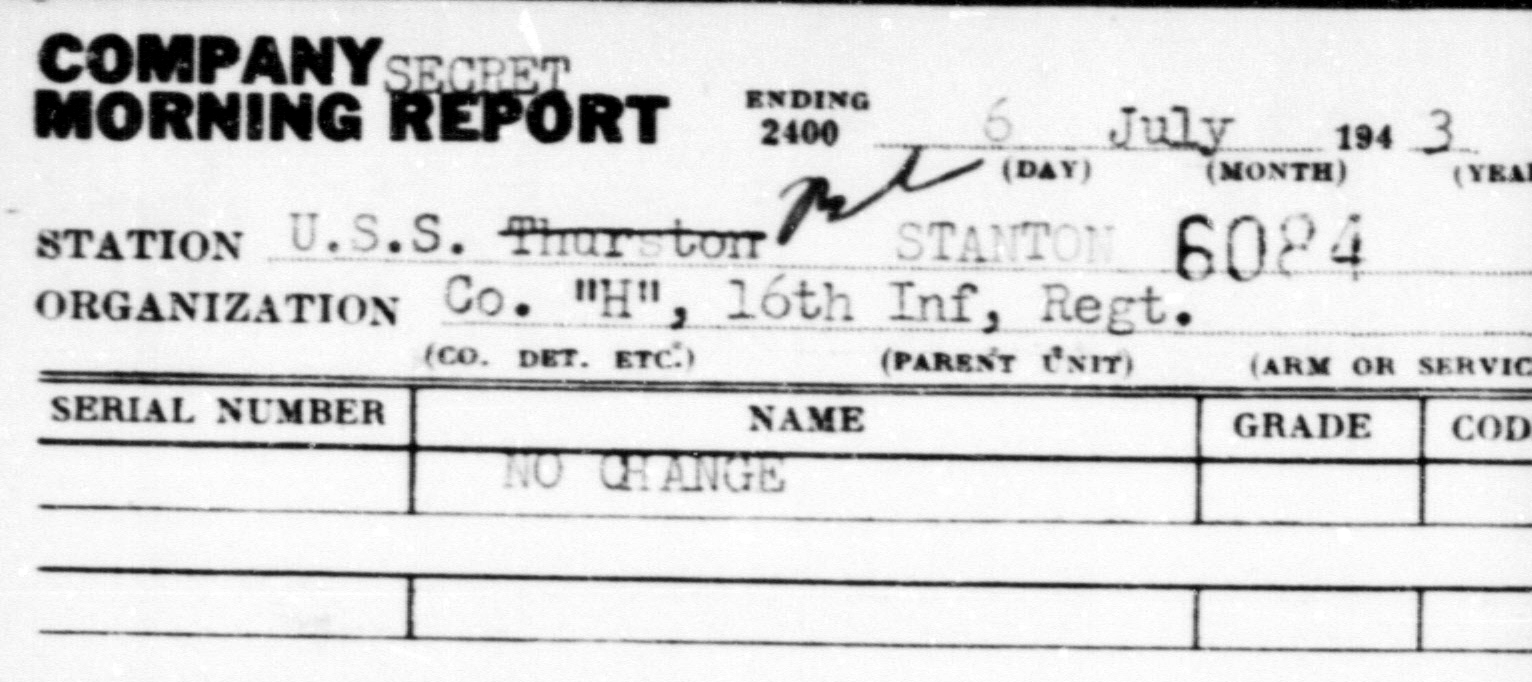
Company H spent the first week of July aboard ship. The morning report for 6 July records nothing, just the two words NO CHANGE. The station line carries the find. The clerk typed U.S.S. Thurston, struck it through, and wrote STANTON beside it.

Without that correction nobody could name the ship he crossed in. He was still on the company’s rolls that day, so he sailed with them and went ashore at Gela four days later.
The strikethrough survives only on the page. Machine-read text turns the crossed-out name and the corrected one into two equal words, so both ships had stood in the record as though the company used each.
scanned record
The station line, corrected: U.S.S. Thurston struck through, STANTON written in.
Source: Company Morning Report, Co. ‘H’, 16th Infantry Regiment, U.S.S. Stanton, 6 July 1943 — NARA RG 64, Morning Reports January 1940 – July 1943, Roll 1567 (3 of 4), NAID 435020421, image 2643
Confirmed — Campaign credit
July – August 1943

Sicilian campaign

Earned battle-star credit for the Sicilian campaign. The invasion of Sicily, where he was wounded on the second day.
Source: Campaign credit — Honorable Discharge (WD AGO Form 53-55)
Context / in progress
July 10–11, 1943

Gela: the counterattack the battalion caught

The 16th Infantry came ashore at Gela before dawn on 10 July and pushed for the high ground toward Piano Lupo, linking up with paratroopers dropped inland. The next day General Conrath sent the Hermann Göring Division’s tanks at the beachhead in two columns. The 2nd Battalion, 16th Infantry stood in the path of one of them. On 11 July, the official history records, it was ‘first to feel the weight of the German attack’ at Abbio Priolo, where its companies and the paratroopers had ‘little time to complete more than hasty foxholes and weapons emplacements’ before the Mark III and IV tanks came on. Company H was the battalion’s heavy weapons company, so its mortars and machine guns were part of that thin line. The battalion held, and by mid-afternoon, with tanks destroyed and disabled, Conrath called the attack off.
Source: Garland & Smyth, Sicily, chs. VII–VIII — the 2nd Battalion, 16th Infantry (Lt. Col. Joseph Crawford) at Abbio Priolo, 11 July 1943. ibiblio.org/hyperwar/USA/USA-MTO-Sicily
Confirmed — Discharge
July 11, 1943

Wounded at Gela, Sicily

He served in Company H, 16th Infantry Regiment, 1st Infantry Division. Company H carried the battalion’s 81mm mortars, the weapon he had trained on. The regiment came ashore at Gela on 10 July, and the next day German armor counterattacked the beachhead. He took what the medical record calls a lacerated bullet wound to the left forearm. His Purple Heart is numbered 156413.

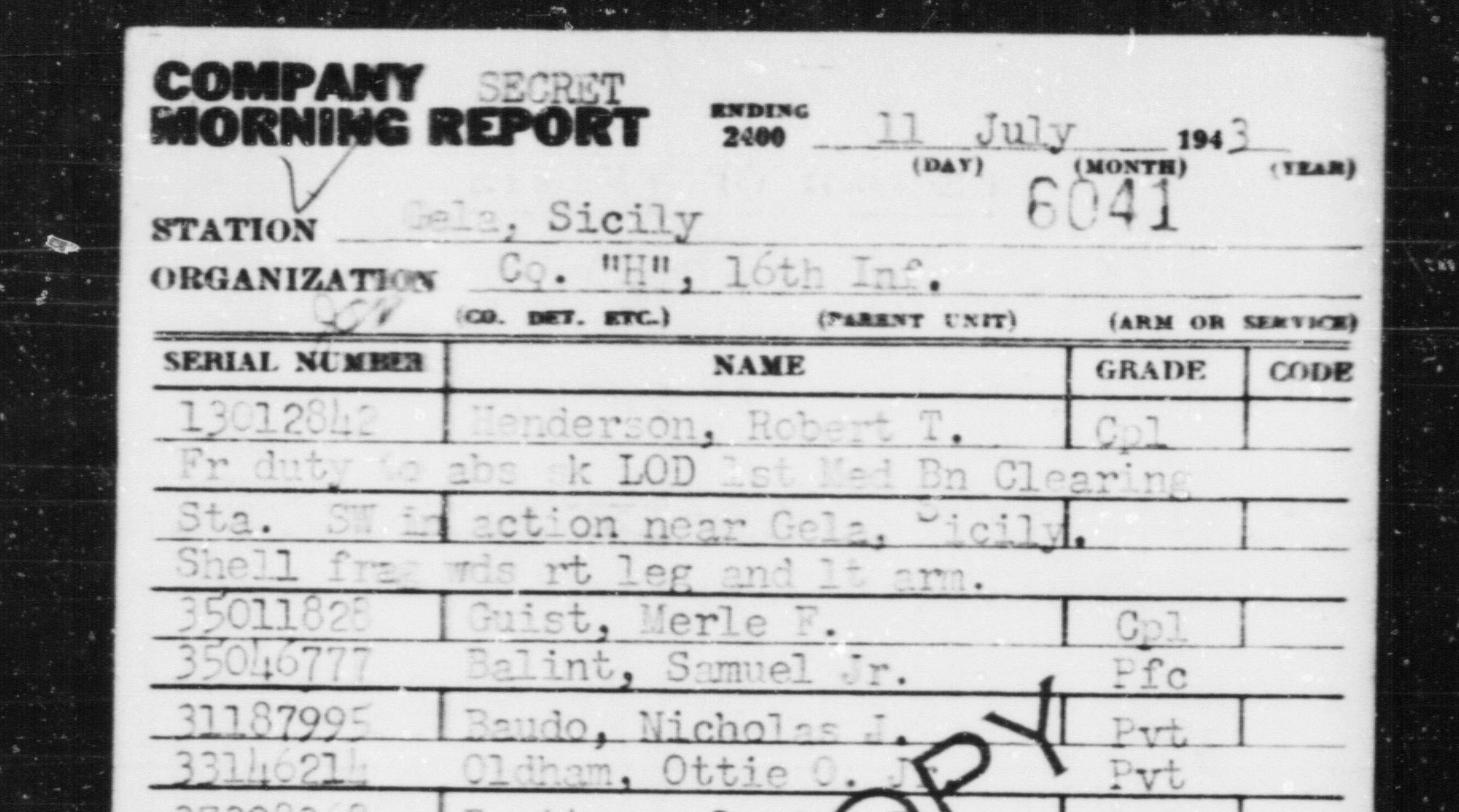
His company wrote it down that night. The morning report for 11 July gives the station as Gela, Sicily, and lists him fifth in a block of men sent off duty to the 1st Medical Battalion Clearing Station. The clerk wrote the reason once, against the first name on the list, and let it stand for the rest:
“Fr duty to abs sk LOD 1st Med Bn Clearing Sta. SW in action near Gela, Sicily. Shell frag wds rt leg and lt arm.”
Those words describe Cpl Robert T. Henderson, at the head of the block. Four names below him: 33146214   Oldham, Ottie O. Jr.   Pvt.
scanned record
Gela, Sicily, 11 July 1943: Company H reports him off duty to the clearing station.
Source: Company Morning Report, Co. ‘H’, 16th Infantry, Gela, Sicily, 11 July 1943 — NARA RG 64, Morning Reports January 1940 – July 1943, Roll 1567 (3 of 4), NAID 435020421, image 2654. Also: Report of Separation (WD AGO 53-55); WWII Hospital Admission Card file (RG 112); 16th Infantry Regiment general orders, 4 September 1943, fiche 1131 (NAID 467293526), image 82
Confirmed — Unit record
July 21, 1943

Dropped from the rolls at Enna

Ten days after Gela he was still at the clearing station, and the company took him off its books. The morning report for 21 July, filed at Enna in the centre of the island, runs a column of fifteen men each marked (abs sk), for absent sick. His line is ninth: 33146214   Oldham, Ottie O. Jr. Underneath the column the clerk wrote the reason once:
“Above 15 EM while abs sk LOD 1st Med Bn Cl Sta drpd fr rolls.”
Dropping a man from the rolls is an accounting move. A soldier absent long enough stops counting against his company’s strength, which lets the company draw a replacement while he is away. He returned to duty four days after this page was written.
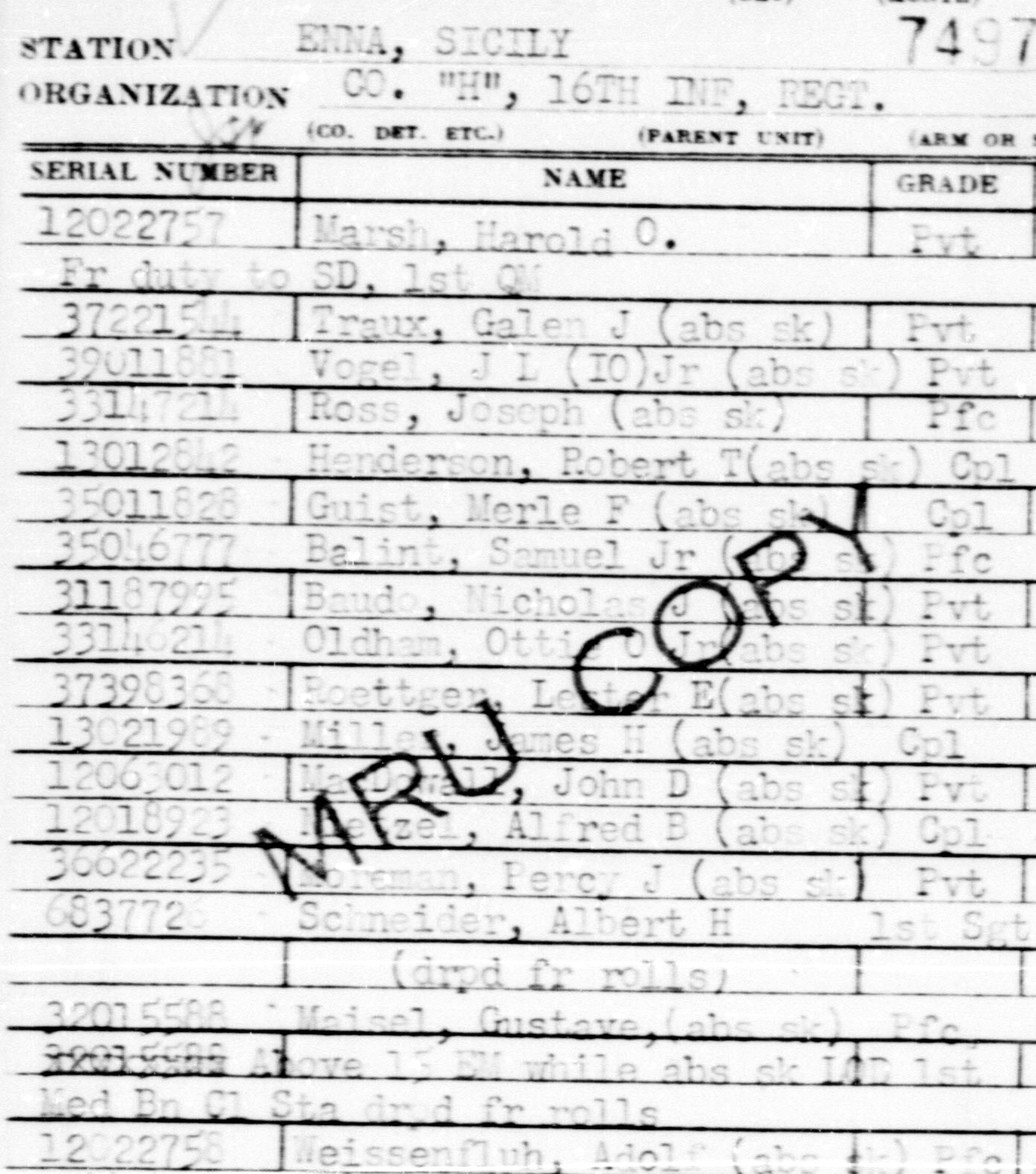
This page turned up two years after the entry that follows it, so the record of his return to the rolls sat in the case long before the record of his leaving them.
scanned record
Enna, Sicily, 21 July 1943: fifteen men dropped from the rolls, his name among them.
Source: Company Morning Report, Co. ‘H’, 16th Infantry Regiment, Enna, Sicily, 21 July 1943 — NARA RG 64, Morning Reports January 1940 – July 1943, Roll 1567 (3 of 4), NAID 435020421, image 2674
Confirmed — Unit record
July 25, 1943

Back to duty at Nicosia, Sicily

Fourteen days after Gela the company clerk put him back on the rolls. Company H had moved inland to Nicosia, in the mountains of central Sicily, and the morning report for 30 July carries his line:
“33146214   Oldham, Ottie O. Jr.   Pvt   (drpd fr rolls)   Fr drpd fr rolls to duty a/o July 25/43.”
The (drpd fr rolls) beside his name points back to Enna four days earlier. Two other men on the same page had just gone the other way, hit near Gangi and sent to the 93rd Evacuation Hospital.
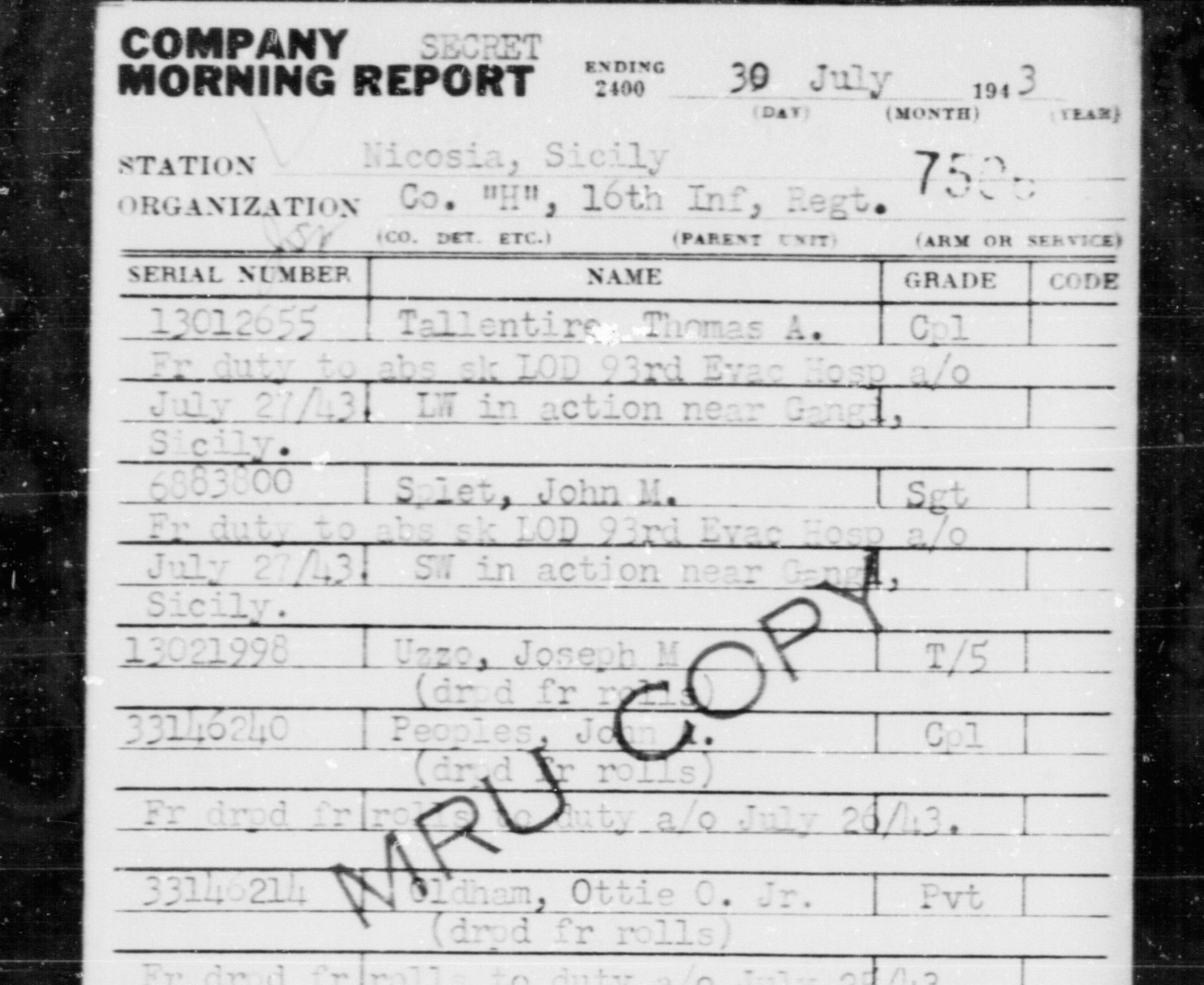
The same page gives his company: Co. ‘H’, 16th Inf, Regt., the heavy weapons company, and the one that held the 81mm mortars he trained on.
scanned record
Nicosia, Sicily: Company H puts him back on duty.
Source: Company Morning Report, Co. ‘H’, 16th Infantry Regiment, Nicosia, Sicily, 30 July 1943 — NARA RG 64, Morning Reports January 1940 – July 1943, Roll 1567 (3 of 4), NAID 435020421, image 2690
Context / in progress
July 1943

Across the middle of Sicily

After Gela the 1st Division drove into the mountainous centre of the island, and Company H’s morning reports trace the route town by town: Niscemi, Mazzarino, Pietraperzia, Enna, Villapriolo, Gangi, Nicosia. By the end of July the division was pursuing the retreating 15th Panzer Grenadier Division east from Nicosia; on 29 July heavy rain and rear-guard resistance stopped the 16th Infantry short of Cerami, with the stronghold of Troina still eight miles beyond.
These are the company’s stations, and for one stretch they are explicitly not Oldham’s. From 21 to 25 July 1943 Oldham was off the company’s rolls at the 1st Medical Battalion clearing station, wounded at Gela and not yet returned. The towns the company passed through in those four days are its route, and not a record of one wounded man’s whereabouts.
Source: Garland & Smyth, Sicily, ch. XVII (the pursuit from Nicosia, halted short of Cerami on 29 July). Stations: Company H morning reports, NAID 435020421, images 2651–2690. ibiblio.org/hyperwar/USA/USA-MTO-Sicily
Context / in progress
August 27, 1943

A telegram reaches Evans, West Virginia

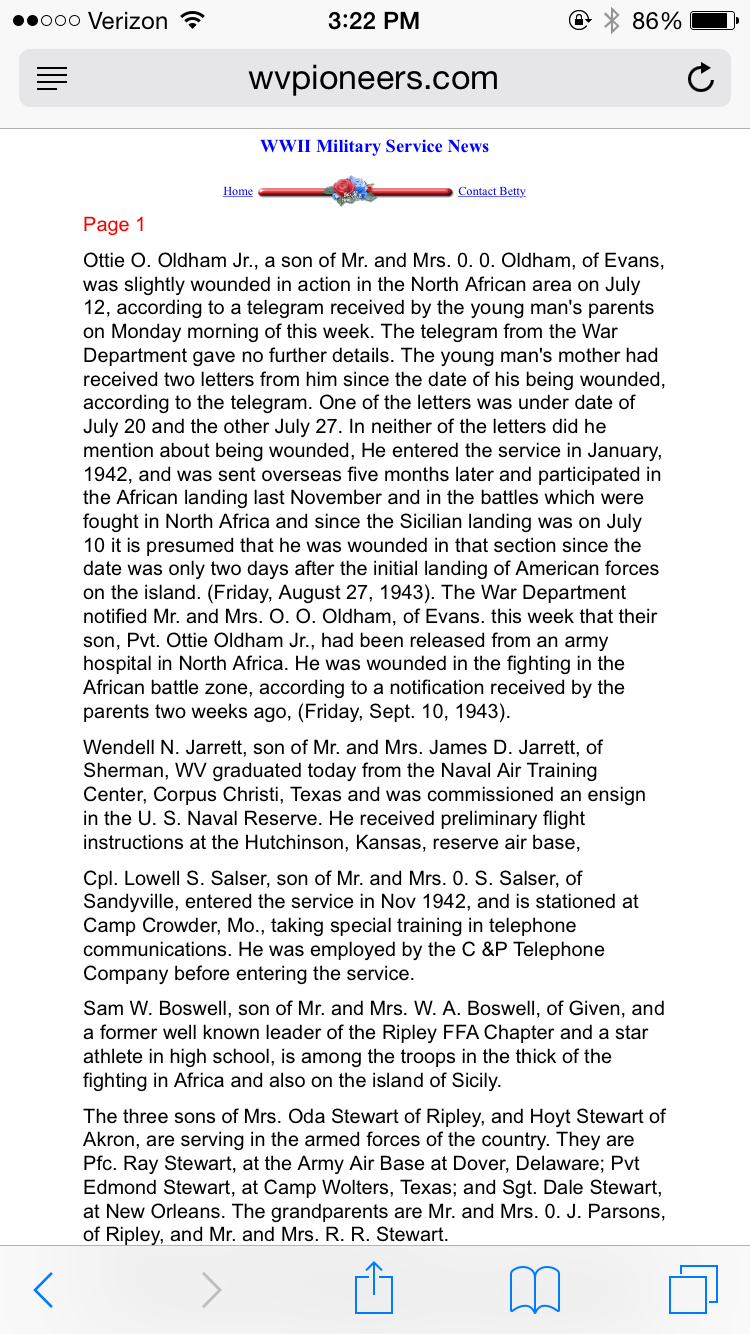
His parents learned he had been hurt six weeks after it happened, and only because the War Department wired them. The hometown paper reported it that Friday:
“Ottie O. Oldham Jr., a son of Mr. and Mrs. O. O. Oldham, of Evans, was slightly wounded in action in the North African area on July 12, according to a telegram received by the young man's parents on Monday morning of this week. … The young man's mother had received two letters from him since the date of his being wounded. One of the letters was under date of July 20 and the other July 27. In neither of the letters did he mention about being wounded.”
scanned record
The paper's wartime service column, as transcribed on wvpioneers.com.
Source: Jackson County, West Virginia weekly, August 27, 1943
Confirmed — Discharge
September 4, 1943

The order that names his regiment

Six weeks after Gela, the 16th Infantry published the Purple Hearts for the men wounded on the beachhead. The list runs alphabetically, and each man gets his company and the number of his medal. His line reads:
“Pvt OTTIE O. OLDHAM, JR., 33146214, Company ‘█’ 16th Inf — 156413”
The name carries the ‘Jr.’, the service number is his, and 156413 is the number printed on his discharge. Until now the only thing tying him to the 16th Infantry was a line his family wrote on a bonus form in 1950, six years after the war. His regiment’s own order says the same thing.
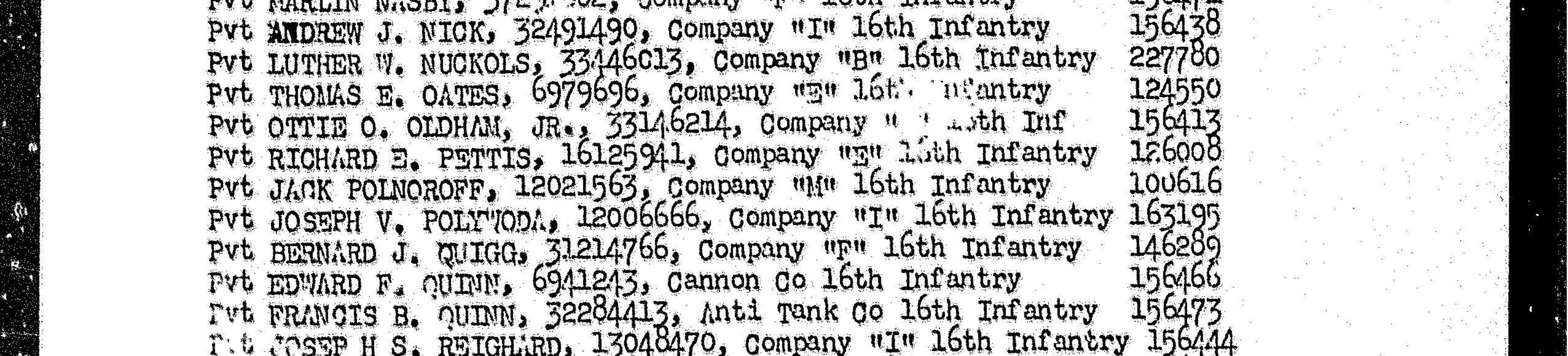
A blemish on the microfilm falls across his company letter and fades the next man’s line as well. The regiment is certain; his company is not.
scanned record
His name, service number and medal number on the regiment’s own order.
Source: 16th Infantry Regiment general orders, ‘Orders (continued)’, 4 September 1943 — NARA St. Louis, RG 64, Army General Orders 1940–1957, fiche 1131 (NAID 467293526), image 82
Context / in progress
September 10, 1943

Out of hospital in North Africa

A second War Department notice told his parents he had left an army hospital in North Africa. Three days later he was in another, and he never went back to a rifle company.
Source: Jackson County, West Virginia weekly, September 10, 1943
Confirmed — Unit record
September 13, 1943

Admitted to the 43rd Station Hospital

Six weeks after Sicily he went into the 43rd Station Hospital at APO 763. A clerk entered him on the day’s admissions with his company beside his name:
“Oldham, Ottie O, Jr   Pfc   33146214   ‘H’ 16th Inf   B12 Psychoneurosis”
He was a private at Gela. He is a Pfc here, so the stripe came in the weeks between.

Company H wrote the same day down from its own side. Its September pay roll lists him under Losses During Month:
“23. Oldham, Ottie O., Jr., 33146214   Jan 27/42 — Drpd fr rolls while abs sk LOD hosp unknown on Sept 13/43.”
The entry says hospital unknown: his company knew he was gone and did not know where.
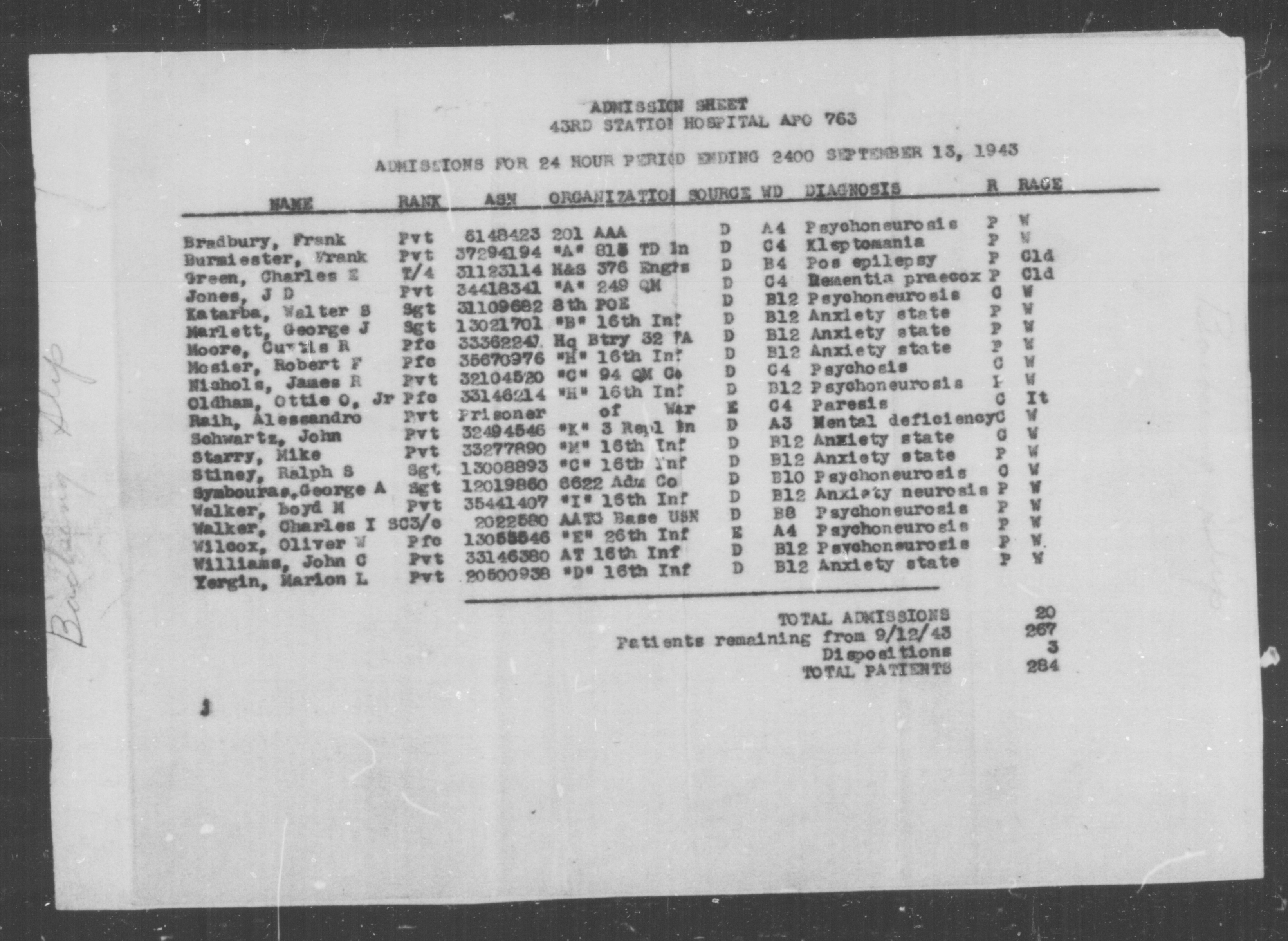
Robert Mosier of Company H was admitted the same day and sits directly above him on the pay roll. Neither clerk knew what the other was writing.
scanned record
The 43rd Station Hospital’s admissions for 13 September 1943.
Source: Admission Sheet, 43rd Station Hospital, APO 763, 24 hours ending 2400, 13 September 1943 — NARA RG 64, Morning Reports for September 1943, Roll 578 (4 of 5), NAID 451670302, image 3026
Confirmed — Unit record
September 20, 1943

Limited service

A week later the hospital discharged him. His line on the disposition sheet reads:
“Oldham, Ottie O, Jr   Pfc   33146214   ‘H’ 16th Inf   B12 Psychoneurosis   LOD Yes   DutyLS”
LOD Yes is the Army’s finding that the condition arose in line of duty, meaning it came from his service. DutyLS is duty, limited service. He could still soldier; he would not go back to a rifle company. Orders that same day sent him to the 7th Replacement Depot, and three weeks later the depot sent him on to the 80th Station Hospital as a supply clerk.
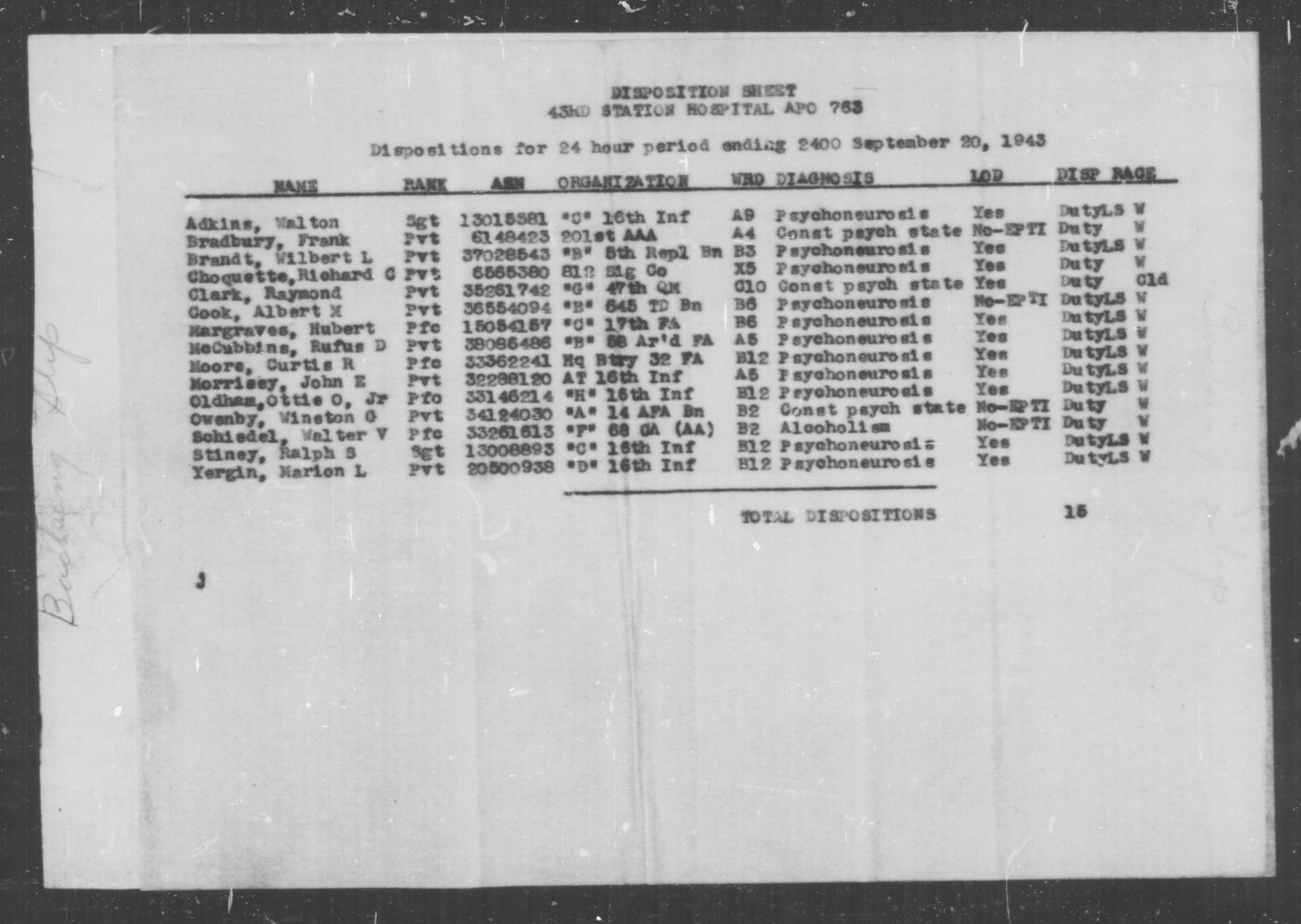
Four other men of the 16th Infantry left the hospital that day with the same diagnosis and disposition: Adkins of headquarters company, Morrisey of the anti-tank company, Stiney of Company C, Yergin of Company D.
scanned record
“LOD Yes — DutyLS”: in line of duty, and limited service.
Source: Disposition Sheet, 43rd Station Hospital, APO 763, 24 hours ending 2400, 20 September 1943, and Special Orders, Headquarters 43rd Station Hospital, 20 September 1943, paragraphs 5 and 6 — NARA RG 64, Morning Reports for September 1943, Roll 578 (4 of 5), NAID 451670302, images 3064 and 3061
Confirmed — Unit record
October 10, 1943

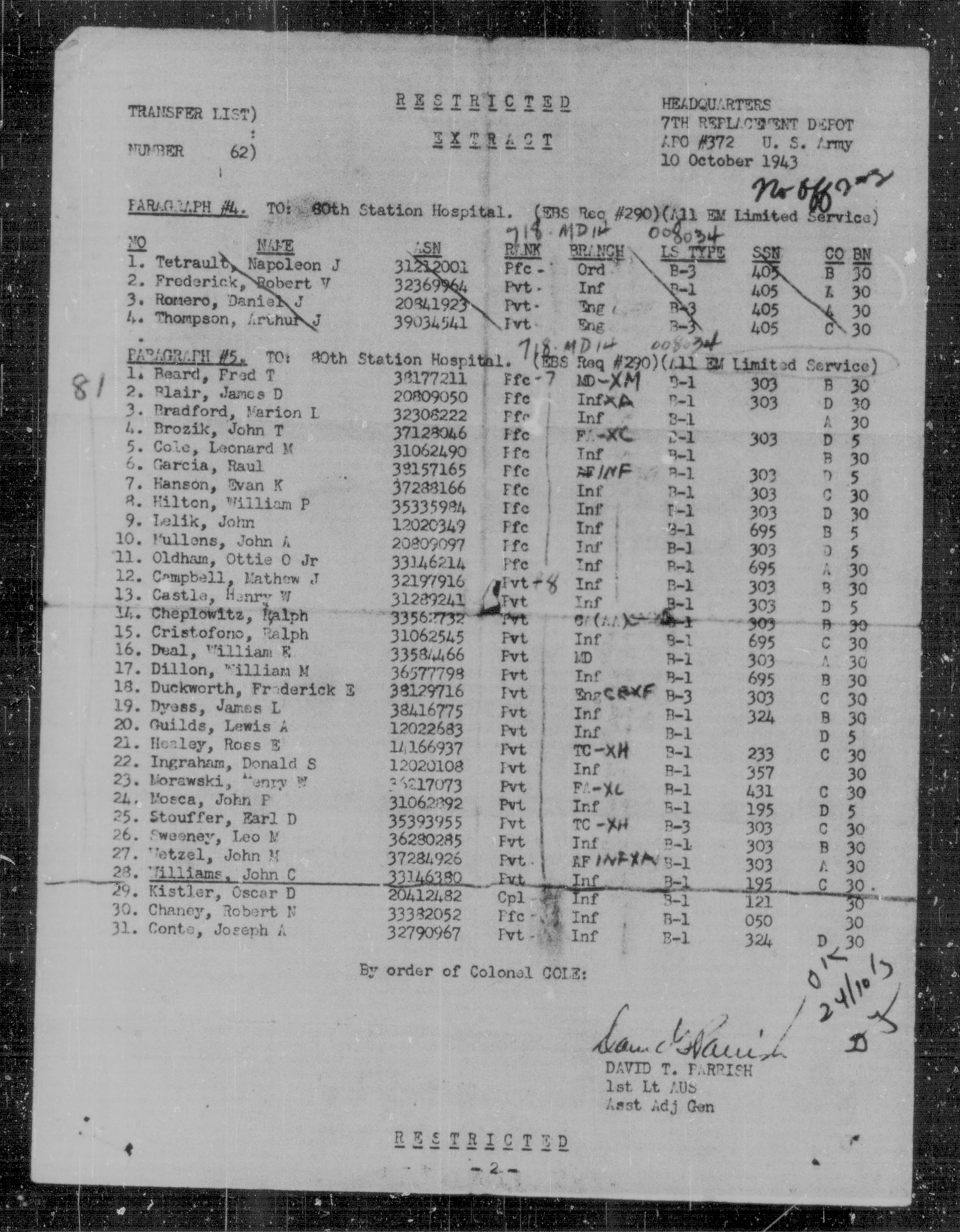
Posted to the 80th Station Hospital

The 7th Replacement Depot moved thirty-one limited-service men to the 80th Station Hospital in a single order. He is number eleven on the list, by name and serial number. Newly discovered. The page also settles a puzzle in his discharge papers: how a man holding a Combat Infantryman Badge ended up carried on the rolls as Medical Department.
scanned record
Line 11: Oldham, Ottie O Jr — 33146214 — Pfc — Inf.
Source: Transfer List No. 62, paragraph 5, Headquarters 7th Replacement Depot, APO 372, 10 October 1943 — by order of Colonel Cole. NARA RG 64, Morning Reports for October 1943, Roll 621 (1 of 5), NAID 454464588, image 618
Context / in progress
November 26, 1943

Evans, West Virginia: his mother learns of the Purple Heart

The Jackson County paper carried the news home:
“Mrs. O. O. Oldham, of Evans, has been notified that her son, Ottie Oldham … has been awarded the Purple Heart … He has now been discharged from the hospital but his wounds were such that he will not see active front line service again but has been given an assignment of limited duty.”
His discharge names the medal and its number but gives no date. This item supplies one: the award reached him in North Africa by late November 1943. The paper calls the wound severe. In August the same paper called it slight, and the Army's medical record describes a bullet wound of the forearm, returned to duty. Take the date from this item, not the description.
Source: Jackson County, W. Va. newspaper, Friday, November 26, 1943 — WWII Military Service News, transcribed by the WVGenWeb Jackson County project (wvgw.net/jackson); the transcription names no newspaper, and the original has not been identified
Confirmed — Unit record
November 26, 1943

The same day: he joins the 80th Station Hospital

Transfer List 62 had ordered him to the 80th Station Hospital six weeks earlier. He reached it on the day his mother read about his medal. He is eighth on the hospital’s roster of men assigned and joined to the Detachment, Medical Department:
“8.   Oldham, Ottie O. Jr   33146214”
Evan K. Hanson is line 4 and William E. Deal line 12. They had come off the same transfer list and arrived together.
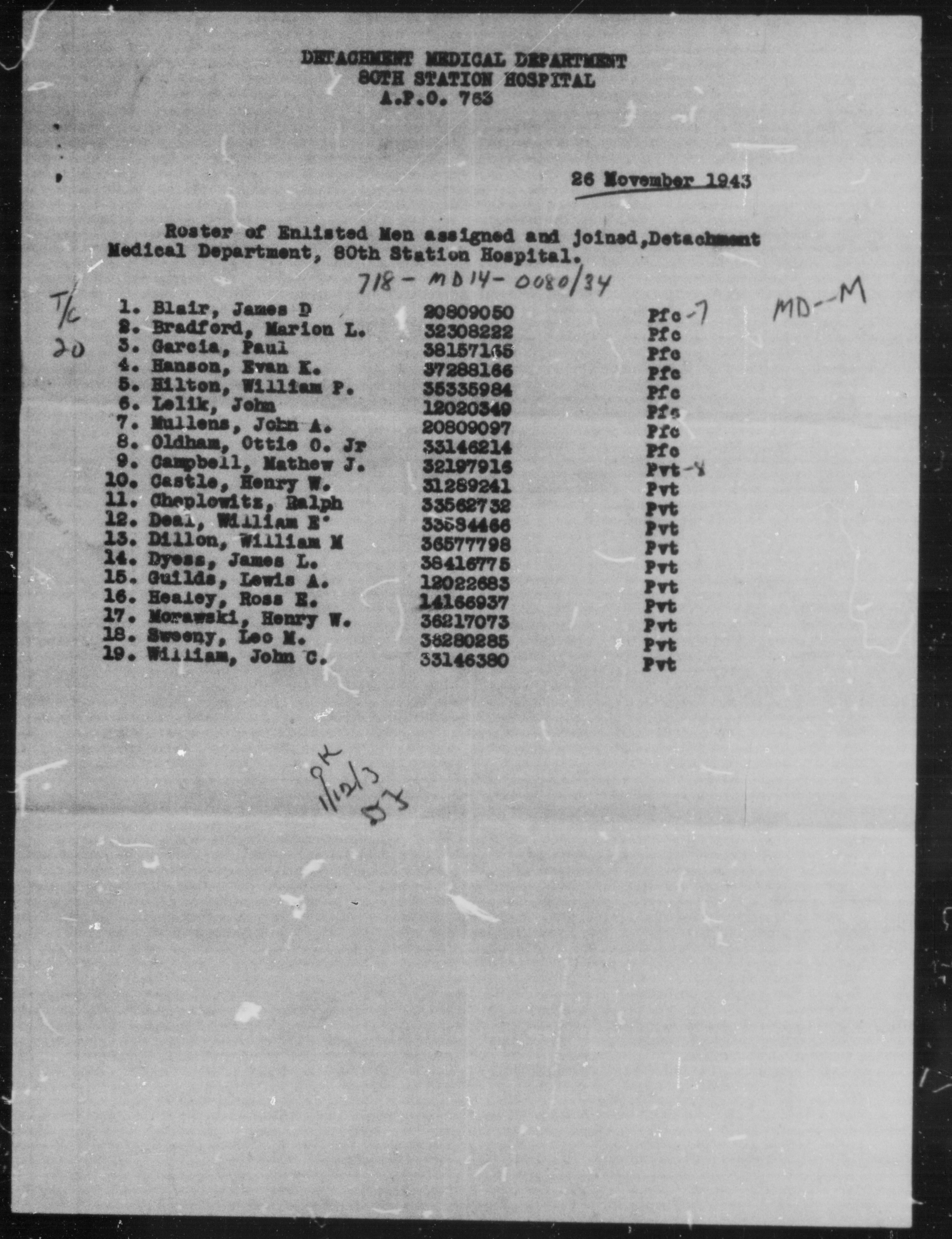
He spent the six weeks between the order and the arrival in the 30th Replacement Battalion at APO 372, which carried him on its books through October and November.
scanned record
The 80th Station Hospital’s joining roster, 26 November 1943.
Source: Roster of Enlisted Men assigned and joined, Detachment Medical Department, 80th Station Hospital, A.P.O. 763, 26 November 1943 — NARA RG 64, Morning Reports for November 1943, Roll 570 (3 of 4), NAID 456829290, image 2363
Context / in progress
September 1943 – February 1944

Bizerte: the 80th on station through the winter

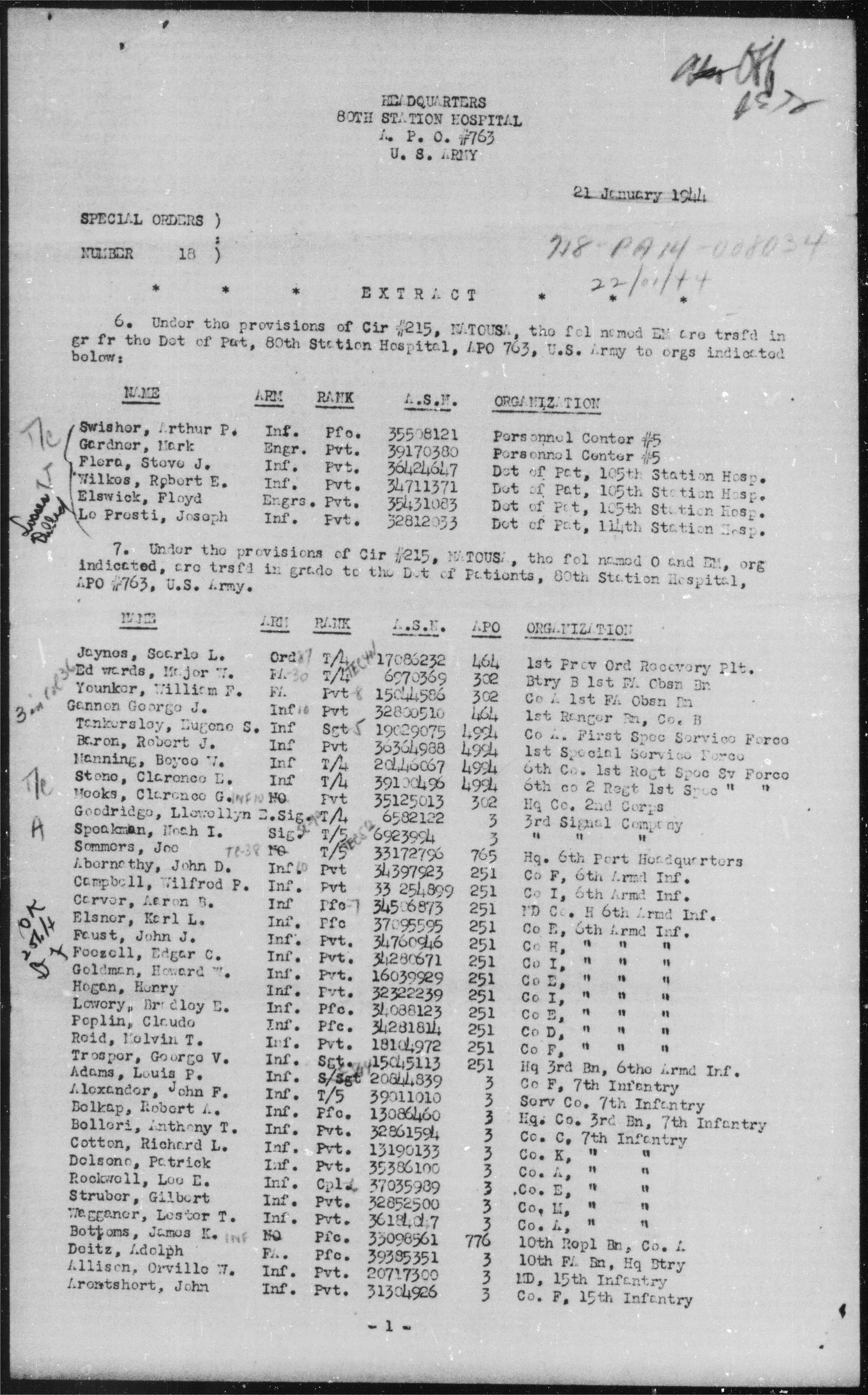
A sweep of the unit's own morning reports puts the 80th Station Hospital at APO 763 every month from September 1943 to February 1944, a 500-bed fixed hospital taking casualties out of the Sicily campaign. He joined it in October and is named again in March. The monthly pages in between do not name him, so his winter here is an inference from two fixed points rather than a documented fact.
scanned record
Special Orders No. 18, Hq 80th Station Hospital, Bizerte, 21 January 1944. He is not named here; the page documents where the unit was.
Source: NARA Morning Reports, 80th Station Hospital rolls, APO 763 throughout Sep 1943 – Feb 1944; shown: Special Orders No. 18, Hq 80th Sta Hosp, 21 January 1944, Roll 0540 pt13 p81 (citation carried from earlier research; not yet re-verified against the roll)
Context / in progress
Winter 1943–44

What a station hospital was

A station hospital was a fixed rear-area hospital that held the sick and the recovering, well behind the fighting. The 80th Station Hospital at Bizerte, on the Tunisian coast, was one of dozens strung across the Mediterranean rear. Men passed through them from the front and, if they could not go back to a rifle company, were put to work in the roles the rear still needed filled: clerks, orderlies and supply hands. It was the kind of place a wounded infantryman reclassified for limited service ended up, and supply-clerk work was the kind of duty such a man was given.
At the 80th, Oldham was a patient first and staff second: sent there on limited-service duty, then kept on as a supply clerk. That turn is documented on the solid-marker cards around this one.
Source: Context for the 80th Station Hospital, APO 763, Bizerte — the placements themselves are on the record cards (NAID 451670302, 454464588, 456829290)
Confirmed — Unit record
March 18, 1944

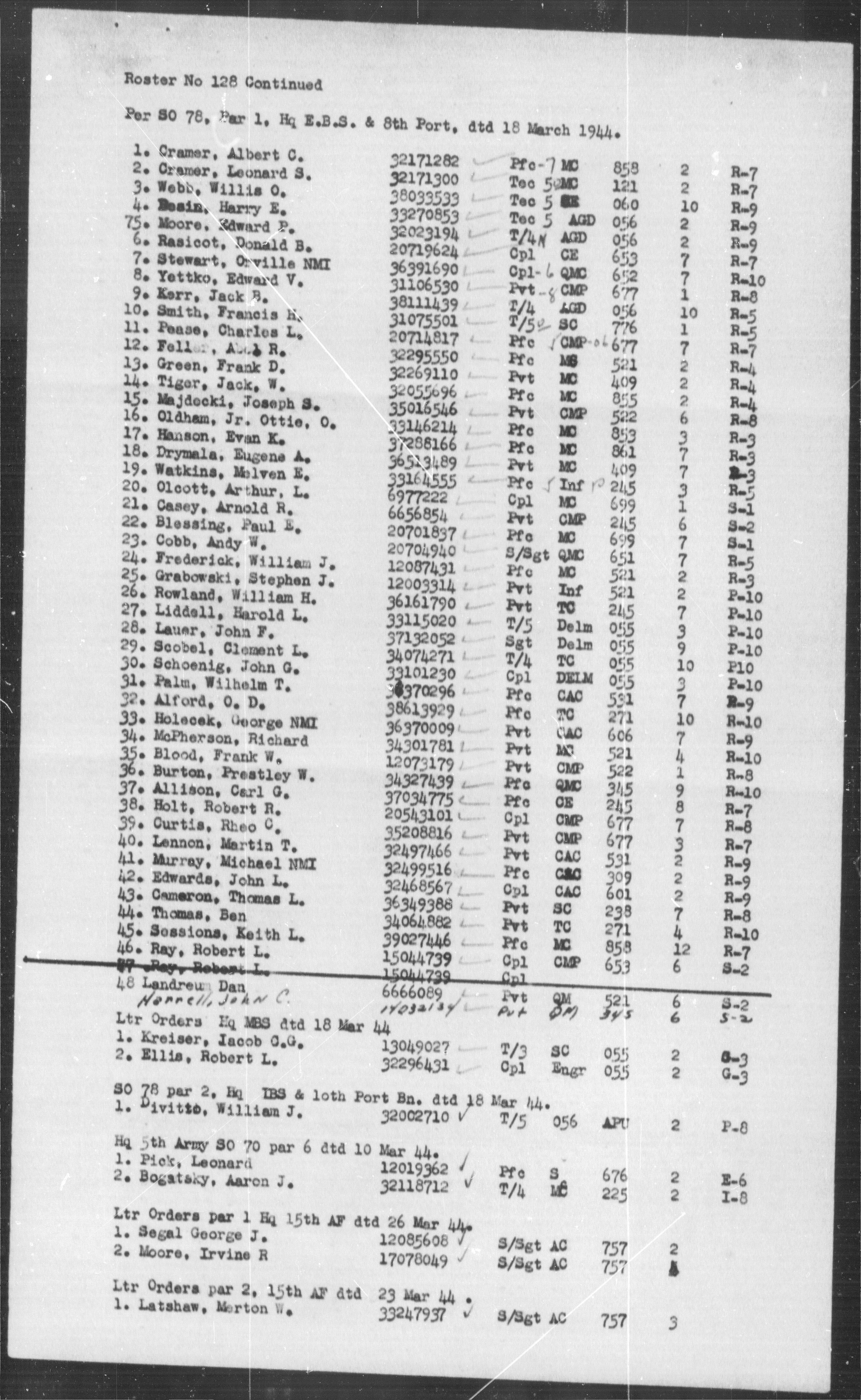
Roster 128: listed for the voyage home

Two days before his hospital morning report, his name appears on Roster No. 128 of Headquarters, Eastern Base Section and 8th Port at Bizerte, the roster cutting orders to send a group of men back to the United States. He is line 16. Newly discovered.
scanned record
His name on line 16 of Roster 128.
Source: Roster No. 128, Hq E.B.S. & 8th Port, per SO 78 par. 1, 18 March 1944 — NARA RG 64, Morning Reports for March 1944, Roll 567 (1 of 3), NAID 466535041, image 608, line 16
Confirmed — Unit record
March 20, 1944

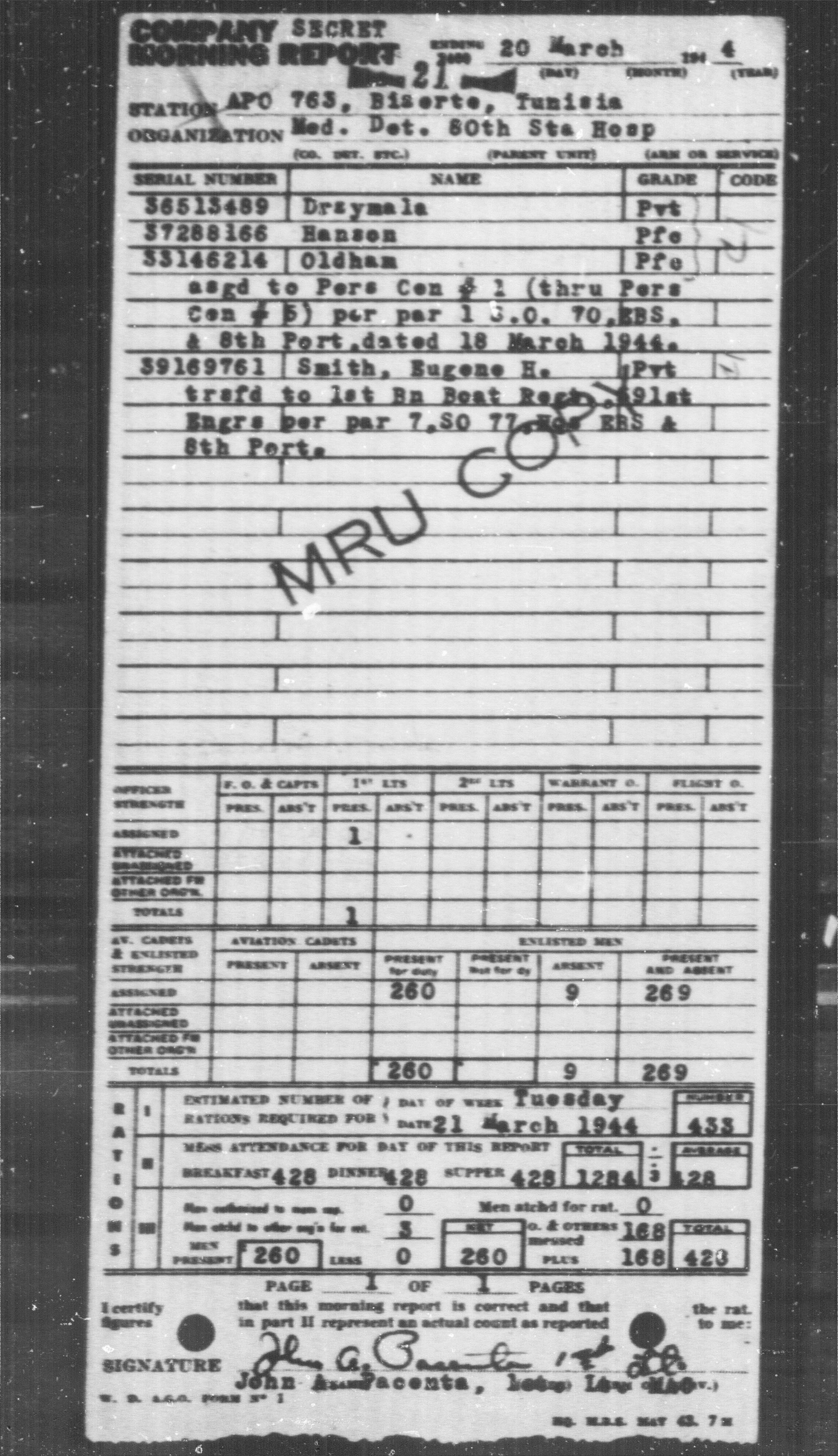
Bizerte, Tunisia: orders home

A morning report of the Medical Detachment, 80th Station Hospital at APO 763, Bizerte, lists three men. He is the third, ordered to a personnel center for the trip home. Newly discovered. Pfc Hanson's name sits directly above his. The two had transferred to the hospital together five months earlier and were still serving side by side.
scanned record
His line, with the order sending him to Personnel Center No. 1.
scanned record
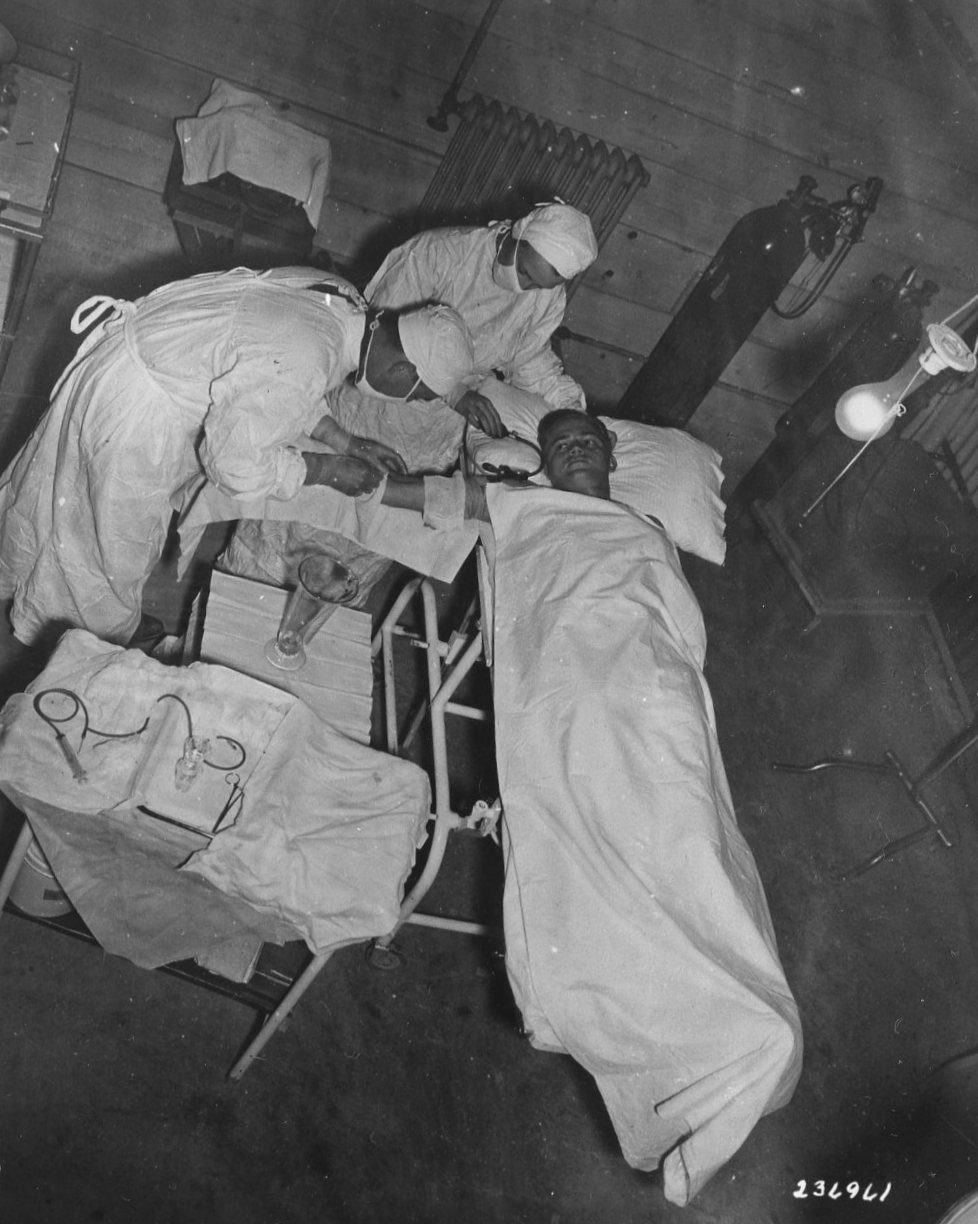
An operating room at the 80th Station Hospital, Bizerte. U.S. Army Signal Corps photograph 111-SC-236961.
Source: Company Morning Report (WD AGO Form 1), Med. Det., 80th Station Hospital, 20 March 1944 — par. 1, SO 70, Hq EBS & 8th Port, 18 March 1944. NARA Roll 0539 pt28 p105 (citation carried from earlier research; not yet re-verified against the roll)
Context / in progress
Spring 1944

How a limited-service man came home

By 1944 the Army was rotating men out of the theatre who could no longer serve at the front: the wounded, the sick, the reclassified. It sent them home under a rotation policy rather than holding them in rear jobs overseas forever. A man tagged for rotation was gathered with others into a numbered group, moved to a port, and shipped back to a reception station in the United States. That is the machinery that carried Oldham from Bizerte to Virginia in April 1944, and the solid-marker cards that follow trace that route by name and number.
Source: The rotation itself is documented on the record cards: the (RMP) list and Rotation Group N32 at Camp Patrick Henry (NAID 466519723 and 468520836)
Confirmed — Discharge
April 17, 1944

Returned to the United States

He came home after one year, eight months and seventeen days overseas.
Source: Honorable Discharge (WD AGO Form 53-55)
Context / in progress
May 5, 1944

Evans, West Virginia: home on furlough

Three weeks after stepping off the boat he was at his parents' house in Evans. The Jackson County paper:
Pfc. Ottie Oldham, son of Mr. and Mrs. O. O. Oldham, of Evans, is spending a furlough with the family, having arrived back in this country only a short time ago from the European theatre of the war. He was wounded in Africa and was awarded the Purple Heart but has now recovered from his wounds received.”
This is the only record of the five weeks between his return on April 17 and his appearance at Camp Reynolds on May 22. His family had not seen him in nearly two years.
Source: Jackson County, W. Va. newspaper, Friday, May 5, 1944 — WWII Military Service News, transcribed by the WVGenWeb Jackson County project (wvgw.net/jackson); the transcription names no newspaper, and the original has not been identified
Confirmed — Unit record
May 22, 1944

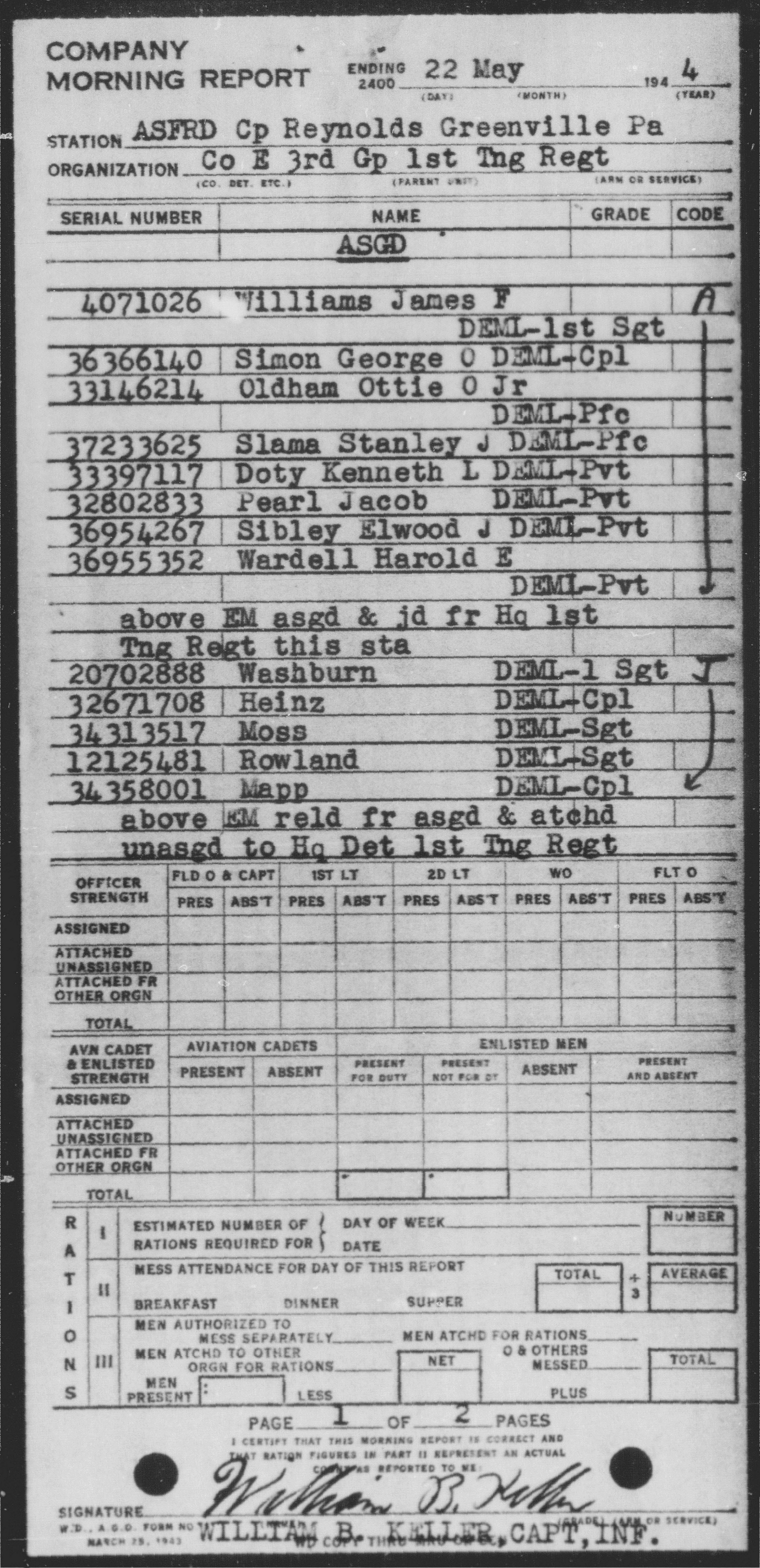
Camp Reynolds, Greenville, Pennsylvania

Home, and on the rolls of Company E, 3rd Group, 1st Training Regiment at the Army Service Forces Redistribution Station, where the Army took in men rotated back from overseas and found them new jobs. He and seven other men joined the company that day from Regimental Headquarters at the same station. Two lines below him on the sheet is Pvt Kenneth L. Doty, who stands beside him on all four of his Pennsylvania reports. He spent the rest of his service here and at Indiantown Gap, working as a supply clerk.
An earlier reading gave his company as B. Two copies of this sheet survive, one of them rotated sideways, and that pass read the sideways one wrong. Enlarge either copy and the letter is E.
scanned record
His name on the Camp Reynolds roll.
Source: Morning Report, 3rd Gp, 1st Tng Regt, ASFRD Camp Reynolds, Pa., 22 May 1944, NARA Roll 0416 pt07 p86 (citation carried from earlier research; not yet re-verified against the roll)
Confirmed — Unit record
October 4, 1944

Attached to the casual detachment

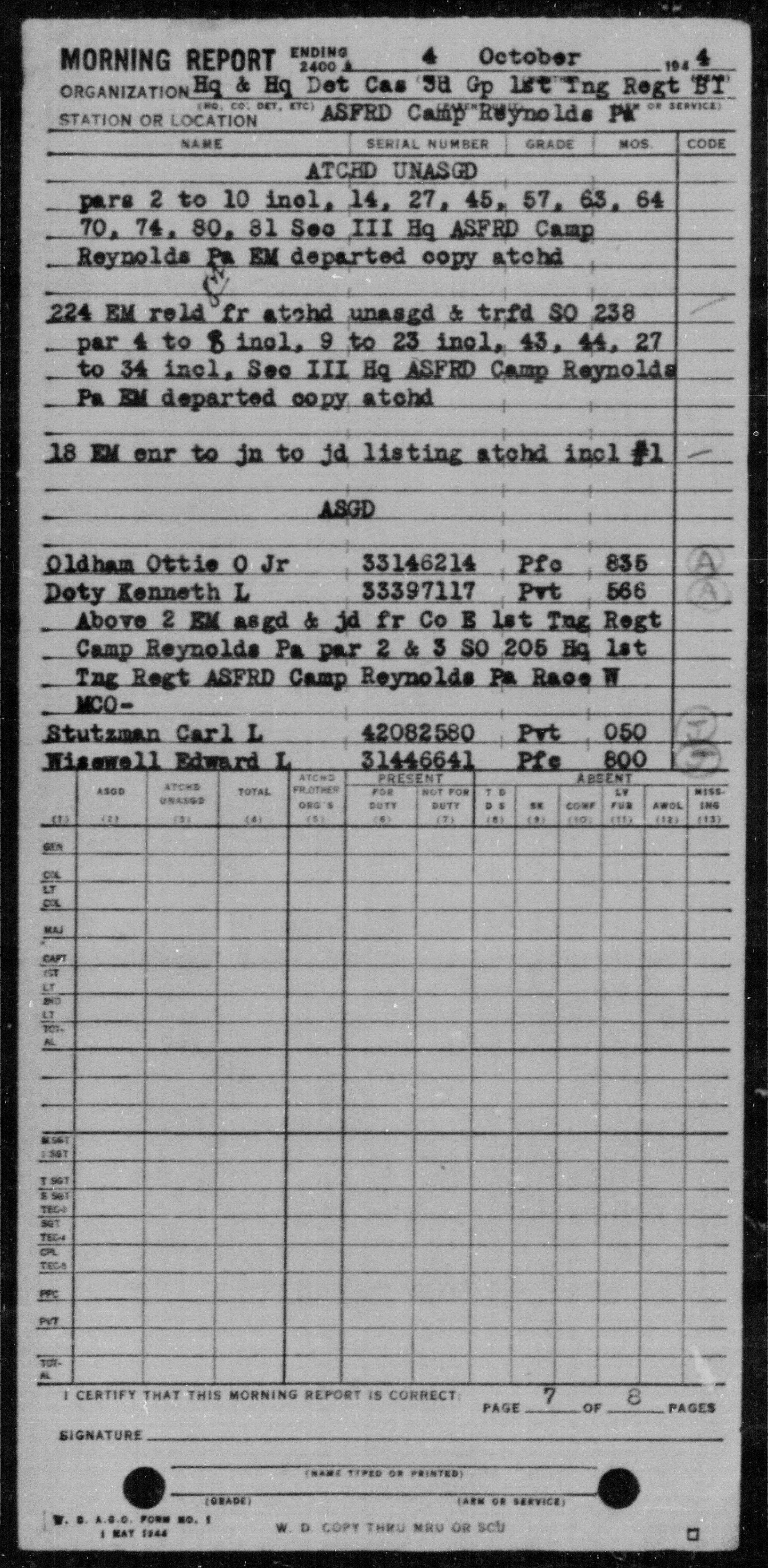
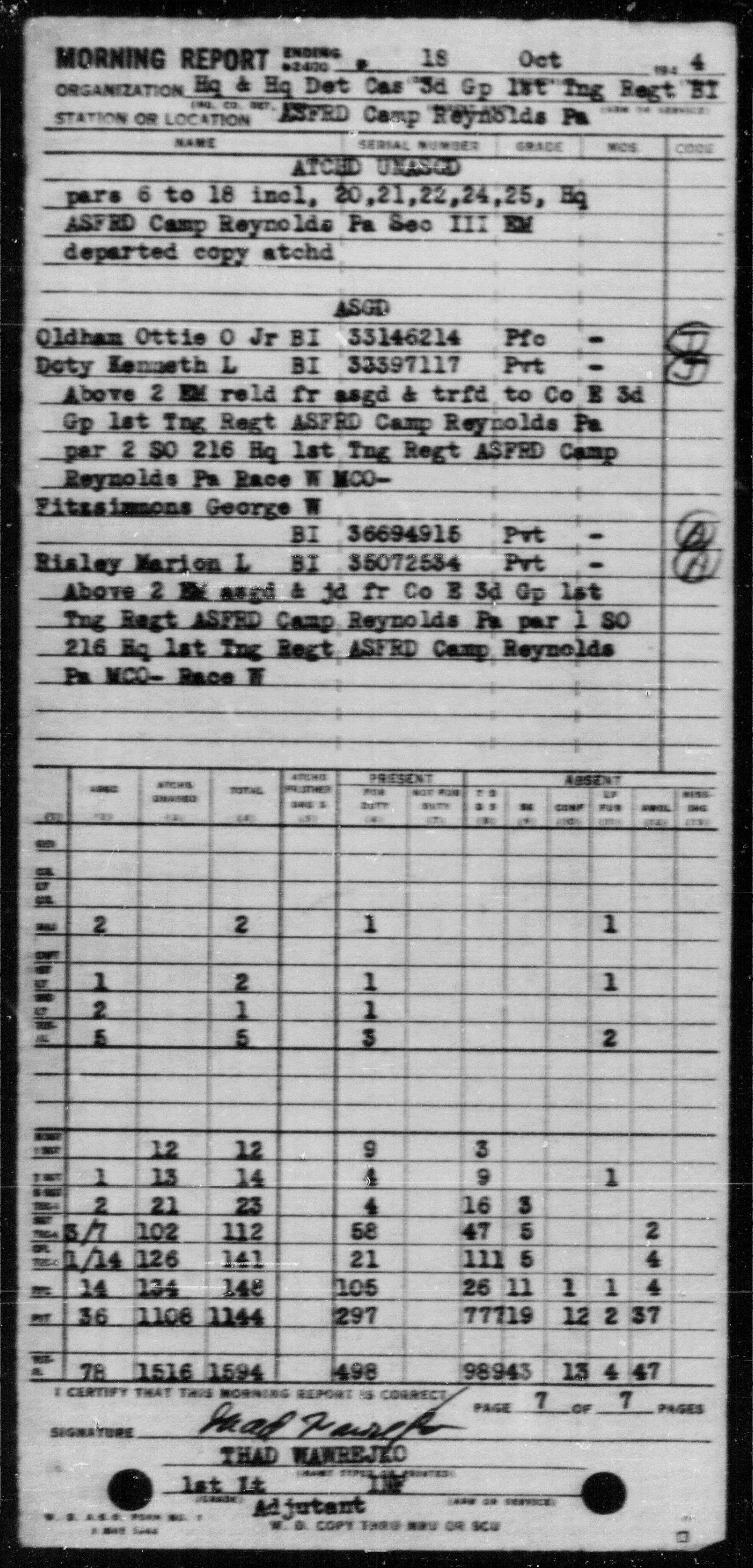
The Army moved him from Company E to the headquarters casual detachment, the holding unit for men awaiting their next assignment, and moved him back two weeks later on October 18. Pvt Doty went with him both ways. His line carries the code 835, the Army's number for a supply clerk. His discharge papers describe the same job two months later.
scanned record
Oldham Ottie O Jr — 33146214 — Pfc — 835, 4 October 1944.
scanned record
Transferred back to Company E, 18 October 1944.
Source: Morning Reports, Hq Det (Casual) and Co. E, 3d Gp, 1st Tng Regt, Camp Reynolds, Pa. — 4 October 1944 (par. 2 SO 205) and 18 October 1944 (par. 1 SO 216): NARA RG 64, Morning Reports for October 1944, Roll 55, NAID 570743714, images 1685 and 1699; Roll 56, NAID 570746132, image 74
Confirmed — Unit record
November 23, 1944

Company E becomes Company B, 5th Regiment

His discharge names Company B, 5th Regiment, Camp Reynolds as the unit he separated from, and no morning report ever puts him there. The Camp Reynolds report for 23 November explains why:
“23 Nov 44   Co ‘E’ 3d Group 1st Tng Regt … as Co ‘B’ 5th Regt, Cp Reynolds, Pa.”
The camp renamed the company. He did not move, and the two names on his paperwork are the same unit either side of a reorganization. The same report released him and Doty to Indiantown Gap.
Source: Morning Report, Co. ‘B’ 5th Regt, ASFRD Camp Reynolds, Pa., 23 November 1944 — NARA RG 64, Morning Reports for November 1944, Roll 272, NAID 575109546, images 1612 and 1613
Confirmed — Unit record
November 24, 1944

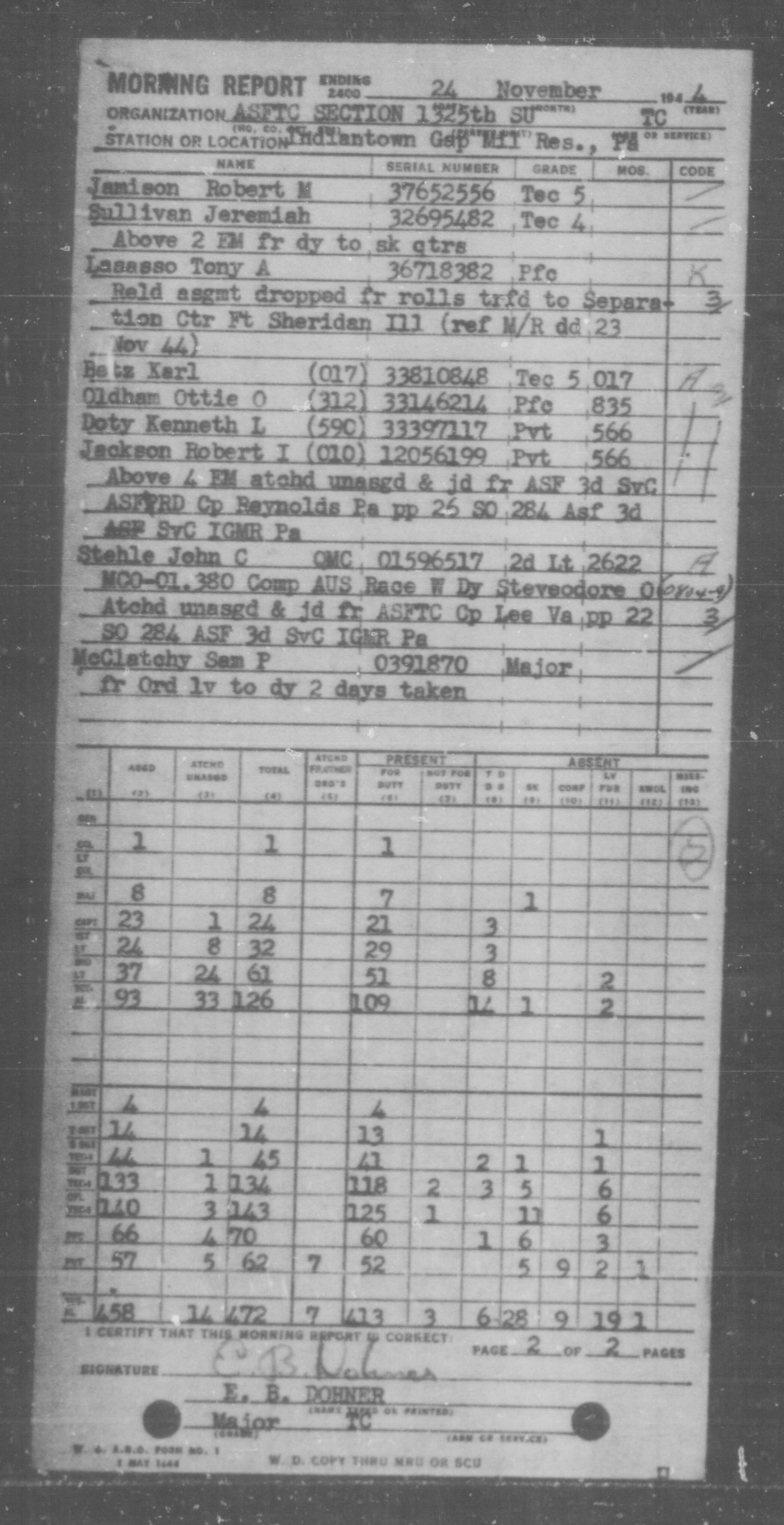
Indiantown Gap, Pennsylvania: the last station

His final posting before separation. Headquarters Indiantown Gap Military Reservation cut the order that discharged him three weeks later.
scanned record
The last morning report that names him.
Source: Morning Report, ASFTC Section, 1325th SU, Indiantown Gap Mil. Res., Pa., 24 November 1944 — NARA RG 64, Morning Reports for November 1944, Roll 177, NAID 574549510, image 592
Confirmed — Unit record
December 9, 1944

Dropped from the rolls for Fort Dix

Indiantown Gap struck him off its rolls and sent him to the Separation Center at Fort Dix, New Jersey, under paragraph 51 of Special Orders 292. The discharge order carries his job codes and the address the Army was sending him back to:
“Pfc Ottie O Oldham Jr   33146214   835   302   133 Oliver St, Aliquippa, Pa”
That is the address he gave the Army on the way in, still on his file on the way out.
Three men go down the page with him: Cpl Mark D. Persi of Donora, Pvt Kenneth L. Doty of Mapletown, and Pvt Robert R. Michalowich. Doty appears beside him on every report that names him from May onward.
Source: Special Orders 292, par. 51, ASF 3d Service Command, Indiantown Gap Military Reservation, Pa., discharge under AR 615-365 and WD Cir. 370, 1944, EDCMR 9 December 1944 — NARA RG 64, Morning Reports for December 1944, Roll 133, NAID 577530283, images 45 and 1137
Confirmed — Unit record
December 11–13, 1944

The last three days, hour by hour

A clerk at Fort Dix typed the men leaving the Army that week onto one sheet, thirty names in alphabetical order. He is number sixteen:
“16   Oldham, Ottie O., Jr.   Pfc   33146214”
Below the names he typed the schedule the thirty of them would follow. Orientation ran Monday at half past three. Tuesday brought the final physical at nine, interviewing and counseling at half past two, and the signing of papers at four. On Wednesday they stood showdown inspection at nine, drew final pay at half past nine, and boarded transportation at ten.
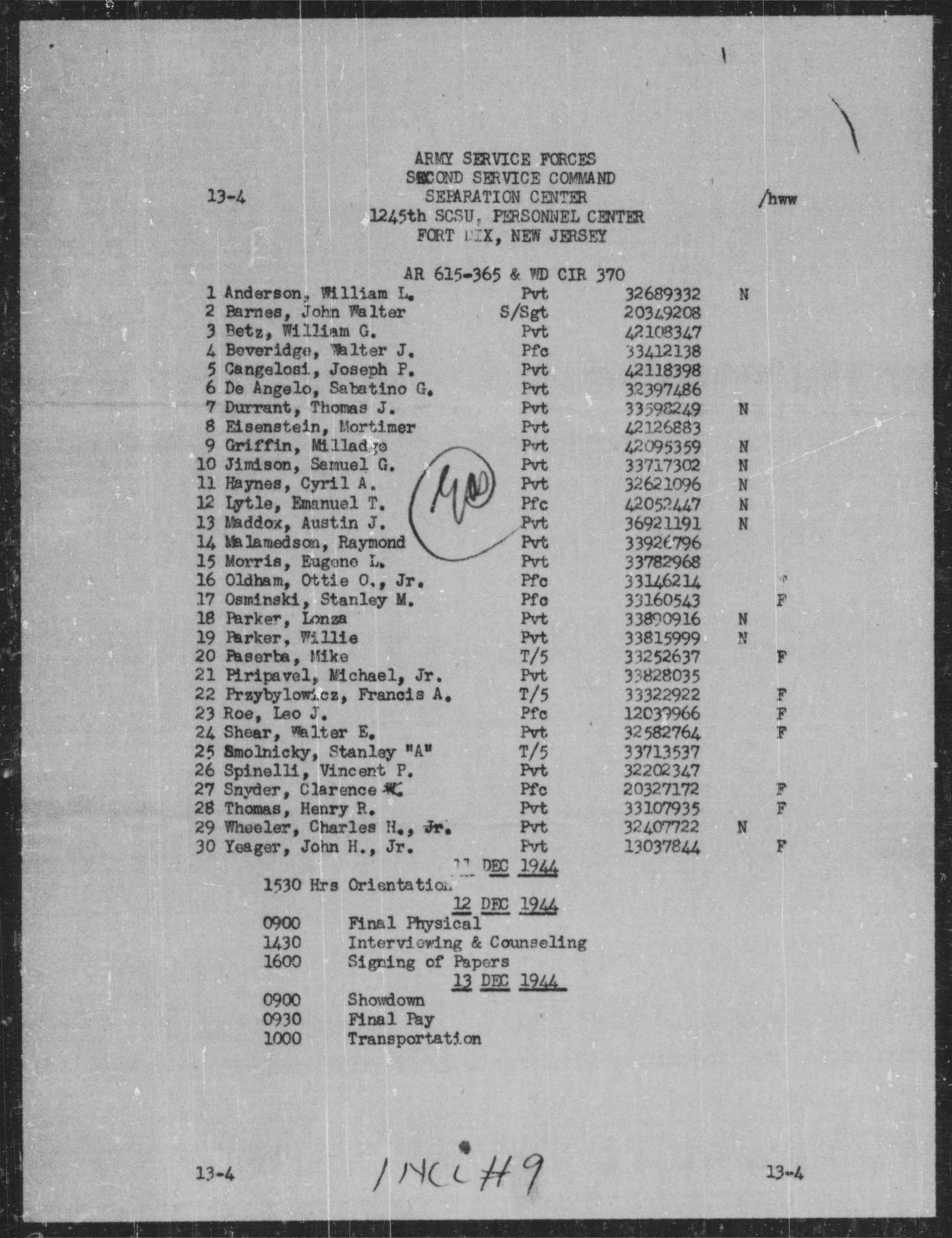
His discharge certificate gives the date and nothing more. This sheet is the only page in the case that records what he did on his last day as a soldier.
scanned record
The Fort Dix separation roster: thirty men, and the timetable they left on.
Source: Separation Center, 1245th SCSU Personnel Center, Fort Dix, N.J., roster under AR 615-365 and WD Cir. 370 — NARA RG 64, Morning Reports for December 1944, Roll 294, NAID 578026118, image 420
Confirmed — Discharge
December 13, 1944

Honorably discharged — Separation Center, Fort Dix, New Jersey

Honorably discharged at Separation Center, Fort Dix, New Jersey as a Private First Class (Pfc). Awards: Purple Heart (No. 156413) — wounded Gela, Sicily, 11 July 1943; Good Conduct Medal; Combat Infantryman Badge; European-African-Middle Eastern Campaign Ribbon.
Source: Honorable Discharge (WD AGO Form 53-55)
Confirmed — Discharge
December 13, 1944

What he earned

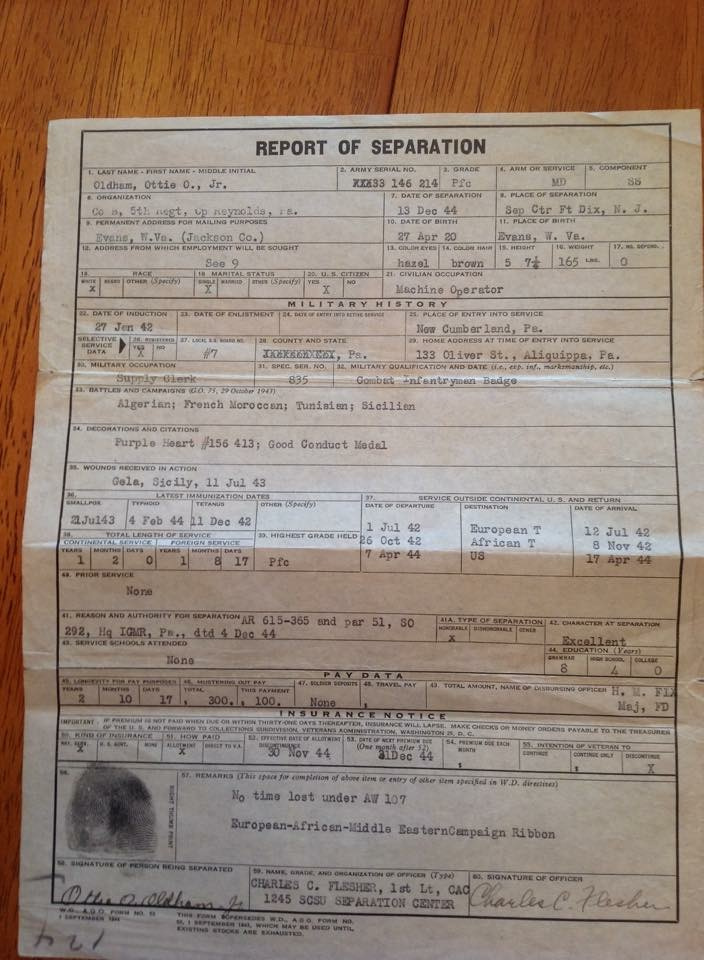
His discharge papers list it, and the list is complete: the Purple Heart, number 156413, for the wound at Gela; the Combat Infantryman Badge, the Army's mark of a man who fought as infantry; the Good Conduct Medal; and the European-African-Middle Eastern Campaign Ribbon with credit for three campaigns. His character of service reads Excellent. No Bronze Star and no unit citation. Because his separation papers survive intact, that absence is evidence rather than a gap in the research.
scanned record
His Report of Separation (WD AGO Form 53), 13 December 1944.
scanned record
The Honorable Discharge certificate.
Source: WD AGO Form 53, Report of Separation, fields 32, 33 (campaign authority G.O. 33, 29 Oct 1943), 34 and 57; repeated on the Enlisted Record sheet
Context / in progress
January 10, 1950

Aliquippa: he applies for the Pennsylvania bonus, and names his unit

Five years after coming home he applied for Pennsylvania's veterans' bonus. The Beaver County record keeps details no other surviving document carries: his organization written as ‘16th Inf 1st Div.’, the Wounded box marked, and a note that his discharge certificate was recorded at the courthouse in Ripley, West Virginia. He named his mother Lillie of Evans as beneficiary. The state paid him $140 for domestic service and $330 for foreign. For a long time this form was the only place his regiment was named, and he had named it himself to claim a bonus. The 16th Infantry’s own award order, found in 2026, says he had it right.
scanned record
‘Organization: 16th Inf 1st Div. — Rank: Pvt 1st Class’, in his own bonus record.
Source: Beaver County World War II Compensation Application Record, filed 10 January 1950, Aliquippa; state application stamped Harrisburg, 2 May 1950
Family record
June 27, 1983

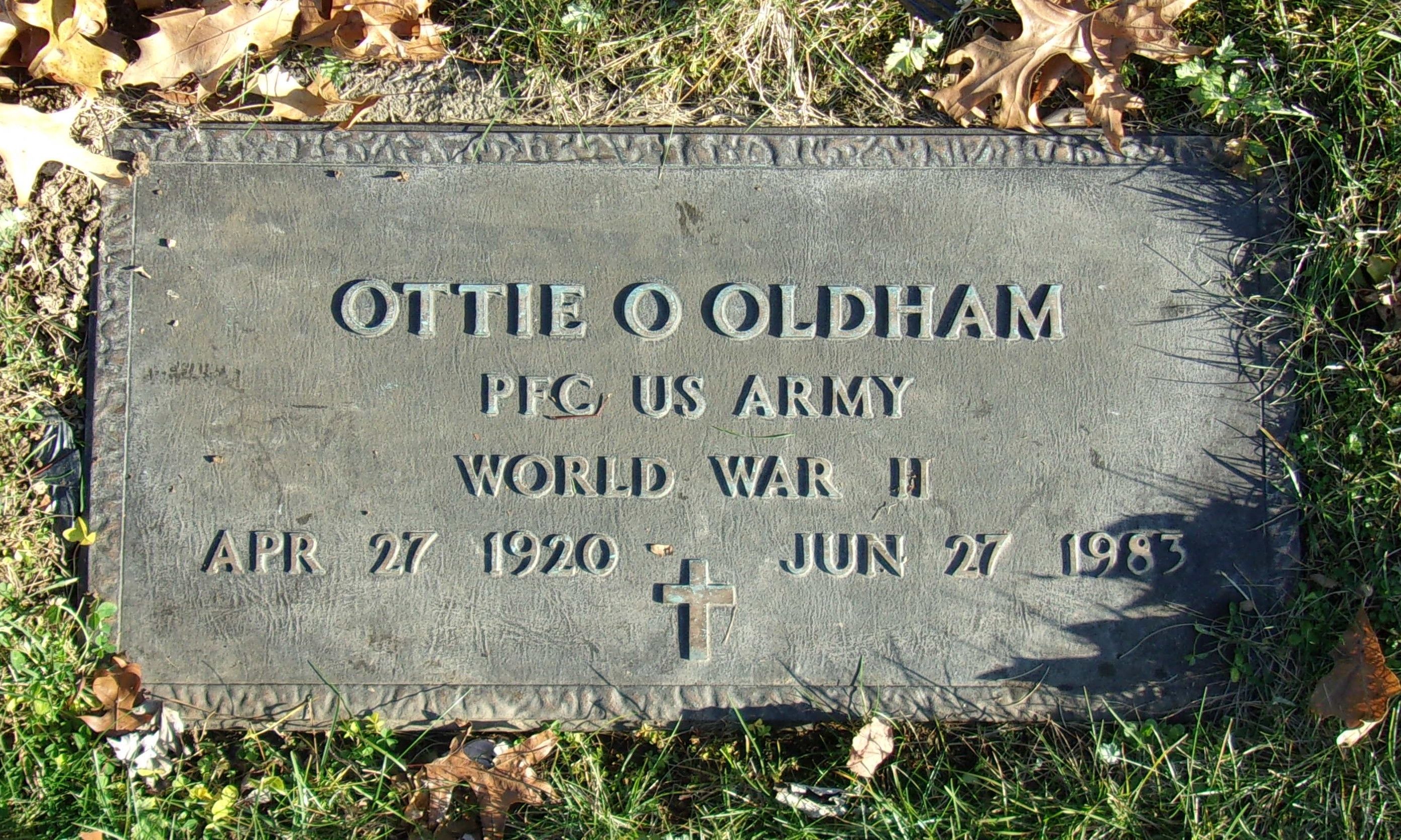
Ottie Owen Oldham Jr. passes away

After the war he went back to the boiler shop at Jones & Laughlin Steel, the job he had been drafted out of, and retired from the same company. He died at Allegheny General Hospital in Pittsburgh, aged 63, and is buried at Woodlawn Cemetery in Aliquippa.
scanned record
His grave marker at Woodlawn Cemetery, Aliquippa, Pennsylvania.